
How many patient calls is your practice missing?
Most dental practices miss 30-40% of inbound calls. See how AI reception can capture every call 24/7.
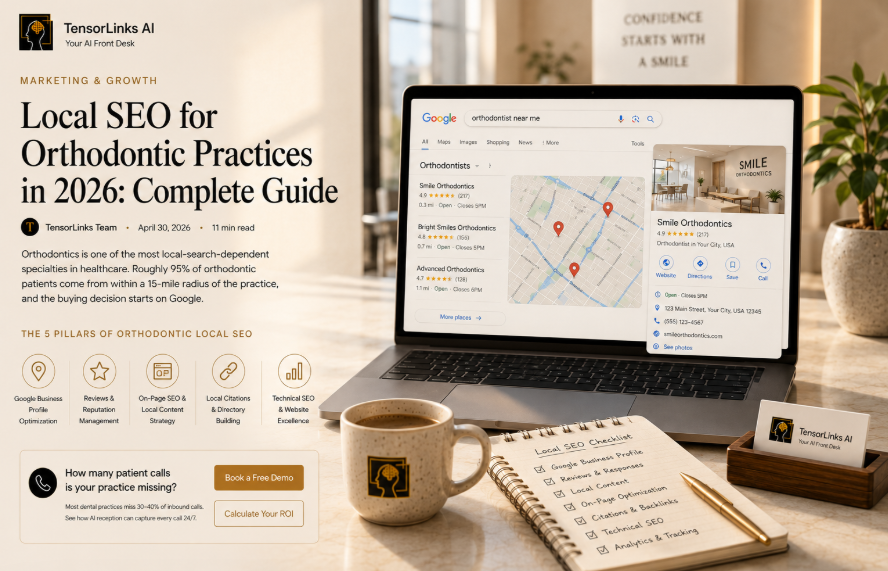
Orthodontics is one of the most local-search-dependent specialties in healthcare. Roughly 95% of orthodontic patients come from within a 15-mile radius of the practice, and the buying decision starts on Google. If your practice is not in the top three local results for queries like "orthodontist near me" or "Invisalign [city]", you are not in the consideration set. This guide is the 2026 local SEO playbook for orthodontic practices — the foundation work, the technical layer, the review strategy, and the gap most practices miss between ranking and revenue.
Why Local SEO Is the Highest-Leverage Marketing Channel for Orthodontics
Orthodontic case values are large — full Invisalign cases run $5,000 to $8,000, and traditional braces $4,000 to $7,000. A single new case from organic search returns more than most practices spend on local SEO in an entire year. The economics break down like this:
- Average case value: $5,500 (mix of Invisalign, braces, retainers, and consultations)
- Acquisition cost via paid ads: $250-$450 per new ortho consult, depending on geography
- Acquisition cost via organic local SEO (mature): approaches $0 incremental cost per consult once the rankings are in place
- Lifetime value uplift: orthodontic patients refer family members at higher rates than general dental patients
The catch is that local SEO compounds slowly. Practices that start the foundation work in 2026 will see meaningful ranking shifts in 2027. Practices that wait will be competing against five years of compounding work from the practice down the street.
The 5 Pillars of Orthodontic Local SEO
Local SEO for an orthodontic practice rests on five technical pillars. Get all five right and the practice ranks. Skip one and the gains plateau.
1. Google Business Profile (GBP) Optimization
Google Business Profile is the single most important asset for an orthodontic practice. It controls map-pack visibility, review display, and the "near me" results that drive most ortho consults.
The GBP work that actually moves rankings:
- Primary category: "Orthodontist" (not "Dentist" — the category match is a major ranking factor)
- Secondary categories: "Cosmetic Dentist" if you offer Invisalign for adults, "Children's Dentist" for pediatric ortho focus
- Service catalog: Invisalign, Traditional Braces, Clear Braces, Lingual Braces, Retainers, Free Consultation, Adult Orthodontics, Pediatric Orthodontics, Surgical Orthodontics, Sleep Apnea Appliances
- Photo cadence: 5-10 new photos per month is the threshold below which Google deprioritizes your listing — patient before/afters (with consent), team photos, office interior, treatment rooms
- GBP posts: weekly posts with offers, events, or educational content keep the profile "active" in Google's view
- Q&A management: seed your own questions and answers, then monitor for new patient questions weekly
- Service-area definition: for ortho practices that serve multiple municipalities, define service areas with surgical precision rather than dropping a 25-mile radius
2. Local Schema Markup
Schema is the technical layer that tells search engines exactly what kind of business you are, what services you offer, and what your patients have said about you. For orthodontic practices, the highest-value schema types are:
- MedicalBusiness / Dentist schema: tags your business as a healthcare provider with specific specialty
- LocalBusiness schema: address, hours, phone, geo coordinates, payment methods accepted
- Service schema: separate Service entries for Invisalign, Braces, Retainers, etc., each with description and pricing if disclosed
- AggregateRating schema: pulls your overall star rating and review count into search results
- FAQPage schema: on service pages, marks up "How long does Invisalign take?" type questions to win featured snippets
- Person schema: for each orthodontist on staff — credentials, specialty, board certifications
Schema does not directly improve rankings, but it dramatically increases click-through rates from search results, which is itself a ranking signal. The compound effect is real.
3. Reviews — Velocity, Recency, and Diversity
Google's local algorithm cares more about review velocity (how often new reviews come in) than total review count. A practice with 80 reviews where the most recent is from last month outranks a practice with 400 reviews where the most recent is two years old.
The 2026 review playbook for orthodontics:
- Target velocity: 10-20 new Google reviews per month is the threshold for sustained ranking gains in competitive metros
- Request timing: ask at appliance delivery (high-emotion moment) and at debond (highest satisfaction moment)
- Multi-platform diversity: Google primary, but also Healthgrades, Vitals, Yelp, Facebook, Zocdoc — Google reads cross-platform reputation signals
- Response cadence: respond to 100% of reviews within 48 hours, both positive and negative — a documented signal Google uses
- Keyword presence in reviews: when patients mention "Invisalign," "braces," or your city name in their review text, that helps you rank for those queries
4. Citations and NAP Consistency
Citations are mentions of your practice name, address, and phone (NAP) on third-party directories. They function as trust signals to Google. The work here is unglamorous but essential.
- Tier 1 directories: Google Business Profile, Apple Business Connect, Bing Places, Healthgrades, Vitals, Yelp, Facebook
- Dental-specific: ADA Find-A-Dentist, AAO Member Directory, 1-800-DENTIST, DentalPlans.com
- Insurance directories: in-network listings on Delta Dental, MetLife, Cigna, Aetna, BCBS — these matter for both citations and patient discovery
- Local directories: Chamber of Commerce, Better Business Bureau, regional newspaper directories
The single biggest mistake practices make: NAP inconsistency. If your phone number on Google says "(555) 123-4567" but on Healthgrades says "555-123-4567 ext 2," Google treats them as different businesses. Use a citation audit tool quarterly to catch drift.
5. On-Site Content and Technical SEO
Your practice website is the conversion endpoint. The on-site work that supports local rankings:
- Location pages: if you have multiple offices, each gets its own URL with unique content (not duplicated boilerplate)
- Service pages: dedicated pages for Invisalign, braces, retainers, consultations — each targeting specific search intent
- City + service pages: "Invisalign in [City]," "Orthodontist in [Neighborhood]" — built only for cities you genuinely serve, not spammed
- Page speed: Largest Contentful Paint under 2.5 seconds, Cumulative Layout Shift under 0.1 — Core Web Vitals are confirmed ranking signals
- Mobile-first design: 78% of "near me" searches happen on mobile; if your site isn't mobile-perfect, you lose
- Internal linking: service pages link to location pages link to FAQ pages link back to service pages — the link equity flows
The Conversion Gap: Why Top Rankings Don't Always Mean New Patients
Here is the part of the orthodontic local SEO conversation most practices miss. You can do everything above perfectly, rank #1 for "Invisalign [city]," and still leave 40-60% of revenue on the table. The reason: search results drive phone calls, and phone calls go unanswered.
Industry data on what happens after a patient finds an orthodontic practice on Google:
What this means in practice: if your local SEO drives 100 new-patient calls per month and you are answering 65 of them, you are paying full SEO cost for 100% of the visibility while capturing 65% of the revenue. The 35% gap is pure leakage.
The most expensive line item in orthodontic marketing is not Google Ads — it is the missed call after a patient finally finds your practice on Google.
Closing the Conversion Gap: AI Front Desk for Orthodontic Practices
AI front desk technology is the operational complement to local SEO. Rankings drive the calls; AI ensures every call gets answered. For orthodontic practices specifically, the high-value behaviors are:
- 24/7 call answering: after-hours consult requests, weekend appointment changes, and emergency calls (broken brackets, lost retainers) all get handled live
- Multilingual call handling: Spanish-speaking parents are a major segment for pediatric orthodontics in most US metros — automatic Spanish detection and conversation removes a friction point
- Insurance verification: AI can collect insurance details on the first call and run real-time eligibility checks, so the patient knows what is covered before the consult
- Treatment-stage-aware scheduling: books consults, records appointments, adjustments, debonds, and retainer checks into the right operatory with the right doctor
- Recall reactivation: the patient who got a quote two months ago and never came back for the consult — AI calls them back with personalized follow-up
- Treatment-plan financing inquiries: handles "do you take CareCredit?" and similar questions without front-desk involvement
Paid Ads Complement: Where Local SEO Stops and Google Ads Begin
Local SEO is the long-game foundation. Google Ads is the demand-capture layer for queries you cannot organically rank for in the short term. The 2026 split most successful orthodontic practices run:
- Branded paid search: bid on your own brand name to defend against competitors who target it (often 10-20% of paid budget)
- High-intent commercial keywords: "Invisalign cost [city]," "free orthodontic consultation [city]" — these convert at 3-7% even with $30+ CPCs
- Geo-fenced display: retarget patients who visited your site but did not call — surprisingly cheap and high-converting
- YouTube pre-roll: short patient testimonial ads in your service area — builds top-of-funnel awareness for $0.05-$0.10 per view
The paid-and-organic combination compounds: paid traffic that converts well becomes organic ranking signal (engagement, branded search, referring page authority).
Frequently Asked Questions
How long does local SEO take to work for an orthodontic practice?
Meaningful ranking shifts typically appear 90-180 days after consistent foundation work begins, with full maturation around 12-18 months. Practices in less competitive metros can see top-three local rankings inside 6 months; major metros like Los Angeles, Chicago, or Houston take 12-24 months for top-three competitive keyword rankings.
Should an orthodontic practice hire a dental SEO agency or do local SEO in-house?
Most practices benefit from a hybrid model. The technical and ongoing work — schema, GBP optimization, citation auditing, technical SEO — is best handled by a specialist or agency. The relational work — review requests, patient testimonial videos, GBP photo cadence — is best handled by the practice team because it requires day-to-day patient interaction.
How important are reviews for orthodontic local SEO compared to other dental specialties?
Reviews matter more for orthodontics than for general dentistry because the case value is higher and the consideration period is longer. Patients comparison-shop orthodontists more aggressively than they do general dentists, and reviews are the primary input to that comparison. Practices in the top three local results for competitive ortho keywords typically have 200+ reviews and a 4.7+ star average.
Can a single-location orthodontic practice compete with corporate ortho chains in local SEO?
Yes — single-location practices often have an advantage because they can build deeper neighborhood authority, accumulate hyperlocal reviews more naturally, and respond personally to every review and inquiry. The corporate chains have brand authority, but local-intent searches favor genuine local presence. Local SEO is one of the few marketing channels where independent practices can outperform DSOs.
How does AI front desk technology improve local SEO performance?
AI front desk does not directly affect rankings. It affects the conversion rate of the traffic local SEO produces. A practice ranking #1 with 65% call answer rate generates roughly the same revenue as a practice ranking #4 with 100% call answer rate. The two work together: local SEO generates the demand, AI front desk captures it.
What is the most common mistake orthodontic practices make with local SEO?
Treating local SEO as a one-time setup rather than ongoing operations. The technical foundation can be built in 30-60 days. The reason most practices stall: they stop the work — review requests slow down, GBP posts taper off, citations drift, no new content gets published. Local SEO is a maintenance discipline, not a project.
Is paid Google Ads still worth it for orthodontic practices in 2026?
Yes, but only as a complement to local SEO, not a replacement. Paid ads capture demand you cannot yet rank for organically and provide instant volume during ramp-up periods. Practices that depend solely on paid ads for new patient acquisition pay 5-10x the cost per case compared to practices with mature local SEO.
How does local SEO differ for adult Invisalign patients vs pediatric orthodontic patients?
Adult Invisalign patients search differently — "Invisalign near me," "clear aligners cost," "adult orthodontist" — and respond to different review content (treatment results, cosmetic outcomes, appointment flexibility). Pediatric ortho patients are searched for by parents — "kids orthodontist," "braces for teens," "free pediatric consultation" — and respond to safety, kid-friendly office content, and parent reviews. Most practices need separate landing pages and GBP service entries for both segments.
Local SEO drives the calls. TensorLinks AI ensures every one of those calls gets answered, booked, and tracked back to source.
See How It Works →Tags: local SEO orthodontic practices, orthodontist SEO 2026, orthodontic Google Business Profile, Invisalign local SEO, orthodontist near me ranking, ortho practice marketing, AI front desk orthodontist, orthodontic call answering, dental specialty SEO
Related articles
More from Marketing & Growth on TensorLinks.
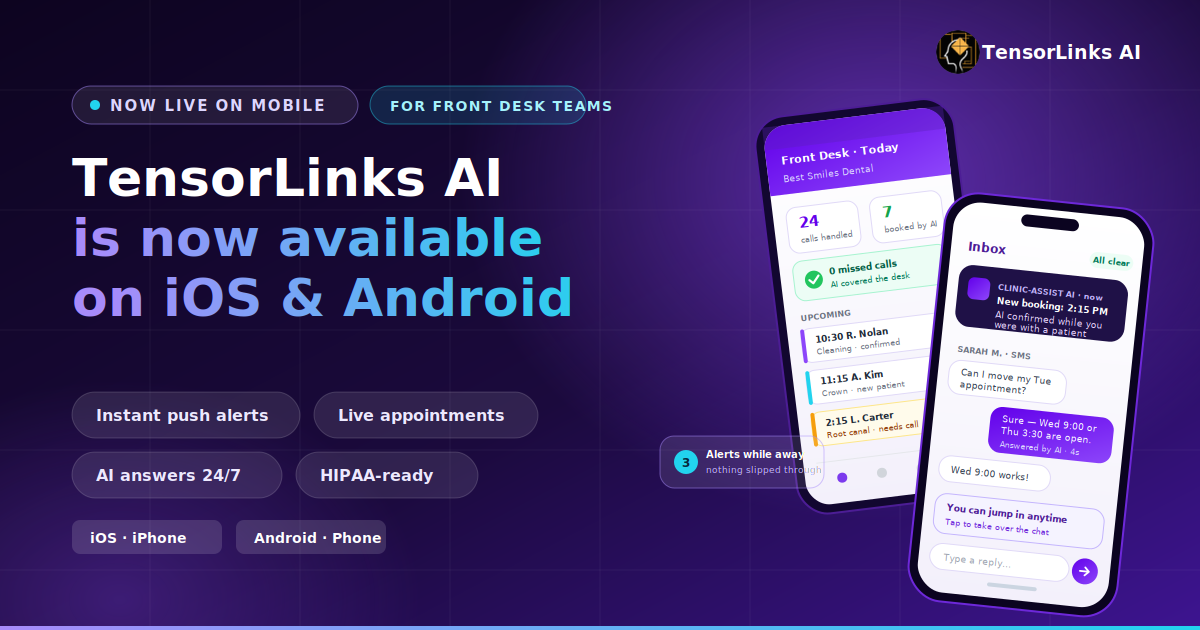
TensorLinks AI Is Now on iOS and Android: Your AI Front Desk, in Your Pocket
TensorLinks AI now runs on your phone. Your AI front desk answers calls and texts 24/7 — and now it reaches you on iOS and Android the moment something needs you. Live calls, patient threads, the schedule, insurance, analytics, and billing, wherever you are standing.

The Evolution of AI Agents: From Simple Assistants to Proactive Systems
Most people still think of AI agents as chatbots — you ask, they answer. That is only the first rung. This is the four-stage path from simple assistants to proactive, monitoring systems, why it is becoming real in 2026 (OpenClaw, Claude Code, Codex), and the real shift underneath: AI moving from a chatbot to infrastructure.
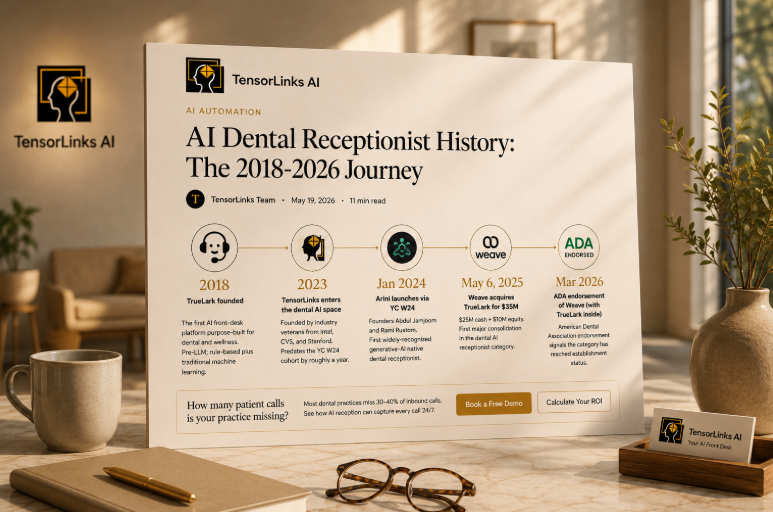
AI Dental Receptionist History: The 2018-2026 Journey
The complete timeline of dental AI receptionists — from TrueLark in 2018, to TensorLinks entering in 2023, to Arini's YC W24 launch, to Weave's $35M TrueLark acquisition. Every founder, funding round, and milestone that shaped the category.
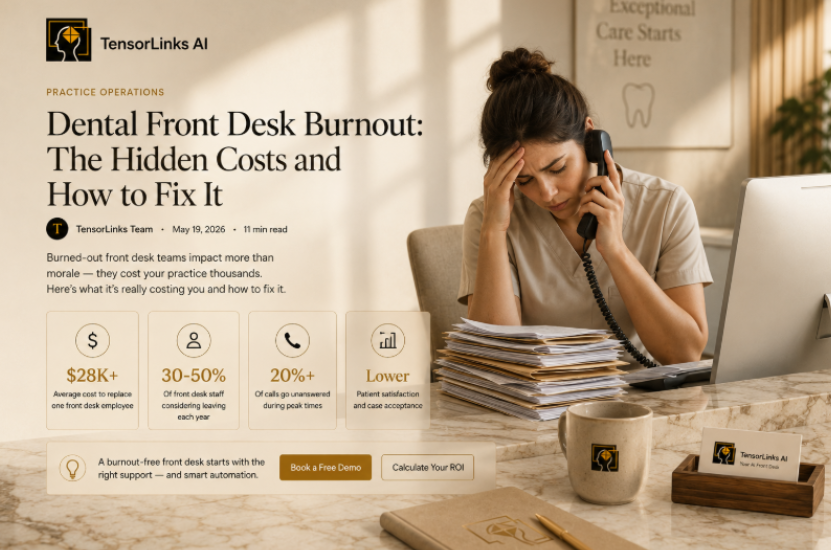
Dental Front Desk Burnout: The Hidden Costs and How to Fix It
Dental front desk burnout drives staff turnover, scheduling errors, and missed-call revenue loss. See what it really costs a practice in 2026 — and how AI fixes it without more hires.
Ready to stop missing patient calls?
TensorLinks AI answers every call 24/7, books appointments into your PMS, and speaks 24+ languages. Join hundreds of dental practices already using AI reception.