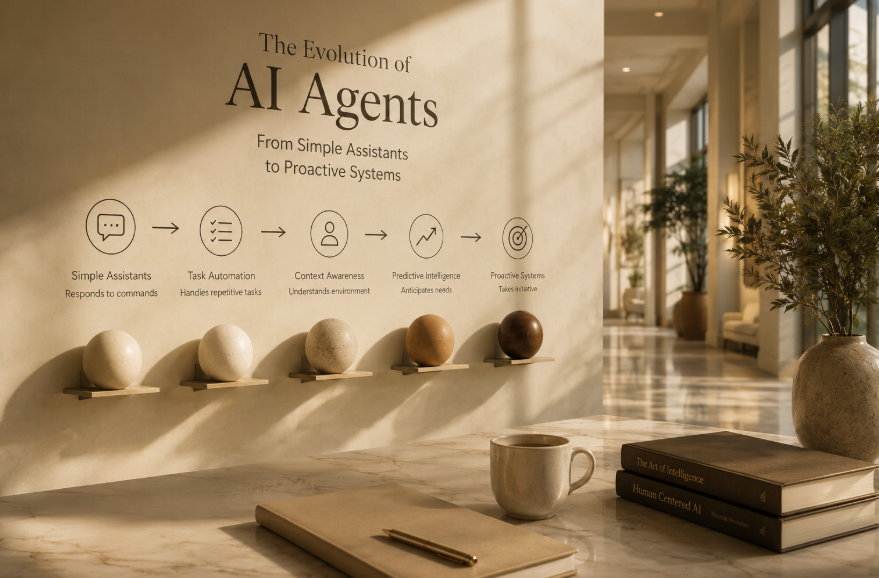
Most people still think of AI agents as chatbots. You ask a question. They answer. That was the first version of the interface — useful, but limited. The agent waited for you. It had no tools, no memory, no triggers, and no real ability to act outside the chat window. That is changing quickly.
The next generation of agents is not just conversational. It is operational. These systems can use tools, coordinate with other agents, monitor events, and act when something important happens. The path looks something like this.
1. Simple Agent
A simple agent is a standalone assistant. You give it a task. It reasons through the request. It responds with an answer.
This is useful for writing, summarizing, brainstorming, coding help, research, and everyday knowledge work. But the agent is mostly limited to what it knows and what you explicitly ask it to do.
It waits.
2. Agent + Tools
The next step is giving the agent tools. Now it can search the web, read files, check calendars, query databases, send emails, run code, create documents, or interact with business systems.
This is where agents become much more practical. Instead of only telling you what to do, they can help do it. A tool-using agent can look at your calendar, draft a follow-up email, update a CRM, analyze a spreadsheet, or generate a report from live data.
The agent becomes less like a chatbot and more like an operating layer across your software.
3. Multi-Agent + Trigger
Once agents can use tools, the next question is coordination. Some tasks are too broad for one agent to handle cleanly. You may want one agent to research, another to write, another to verify sources, and another to check for risks or errors.
A trigger starts the workflow. For example: a new lead enters the CRM. One agent researches the company. Another drafts outreach. Another checks recent news. Another prepares a sales brief. The result is passed back as a finished package.
This is where agents begin to resemble teams, not just tools.
4. Monitoring Agents
The final step is proactivity. Monitoring agents do not wait for a prompt. They watch for important changes and act when something happens.
They might monitor customer usage, inboxes, contracts, support tickets, inventory, market signals, system logs, or operational dashboards. When a condition is met, they can alert the right person, summarize what changed, recommend next steps, or begin a workflow automatically.
This is the real promise of proactive AI: systems that notice what matters before humans have to go looking.
Why This Is Becoming Real in 2026
The shift toward proactive agents is not theoretical anymore. The current agent stack is being built around four practical ingredients: tools, memory, triggers, and permissioned execution.
OpenClaw is one example of the personal-agent direction. It is designed as a self-hosted gateway that connects messaging apps like Telegram, WhatsApp, Slack, Signal, and Discord to AI agents. The important shift is the interface: you message the agent from wherever you already communicate, while the agent keeps sessions, routing, memory, and tool access running behind the scenes.
Claude Code shows the developer-workflow version of this. It can read codebases, edit files, run commands, and work across terminal, IDE, desktop, and browser. More importantly, Claude Code routines can run on schedules, API calls, or GitHub events. That means agents can react to alerts, PRs, deployments, documentation drift, or recurring maintenance work without waiting for a human prompt.
Codex is moving in a similar direction from the OpenAI side. Codex automations can run recurring background tasks, report findings to an inbox, or wake up the same thread on a schedule. Codex also supports subagents, hooks, MCP, skills, and isolated worktrees, which together turn the agent from a one-off assistant into a programmable workflow system.
The market is moving the same way. Gartner expects roughly one-third of agentic AI implementations to combine multiple specialized agents by 2027 — while also predicting that over 40% of agentic AI projects will be canceled by the end of 2027 — usually for weak business value or inadequate controls. The takeaway: the wins come from getting the framework right, not from the model being magically autonomous.
The framework layer matured
Underneath those examples, 2026 was the year the building tools became standardized. In the space of a few weeks, every major lab shipped an agent framework: OpenAI released its Agents SDK and AgentKit (a visual builder, a connector registry, and guardrails), Google launched its Agent Development Kit (ADK), Anthropic published its Agent SDK, and Microsoft shipped Agent Framework 1.0, merging AutoGen and Semantic Kernel into one toolkit. In open source, LangGraph became the default for stateful, auditable workflows, with CrewAI popular for rapid multi-agent prototyping.
They differ in style — directed graphs, role-based crews, handoff chains, hierarchical agent trees — but they converged on the same primitives a proactive system needs: persistent state, multi-agent orchestration, and human approval as a built-in step. The defining design shift of the year was agents that know when to ask for help rather than blindly attempting every task — which is exactly what makes proactivity safe enough to trust.
A shared language for agents
None of this scales without common standards — and in 2026 two emerged and effectively won. The Model Context Protocol (MCP), introduced by Anthropic in late 2024, standardizes how an agent connects to tools and data; it crossed tens of millions of downloads and was adopted across OpenAI, Google, and Microsoft. Google's Agent2Agent (A2A) protocol does the same for how agents talk to each other, regardless of who built them. Both are now under Linux Foundation governance.
Think of them as TCP/IP for agents: MCP is how an agent reaches the outside world, A2A is how agents coordinate with one another. That matters for proactivity, because a monitoring agent is only as useful as the tools it can reach and the specialist agents it can hand work to — and shared standards mean those connections port across vendors instead of being rebuilt every time.
The pattern is clear: agents are becoming infrastructure.
- A simple agent answers.
- A tool-using agent acts.
- A multi-agent system delegates.
- A monitoring agent anticipates.
That last step is the important one. Proactivity is not mainly about the model becoming magically autonomous. It is about the surrounding framework: schedules, webhooks, event triggers, connected tools, scoped permissions, persistent memory, and human review points.
The future agent is less like a smarter chatbot and more like a junior teammate with a calendar, inbox, tools, task queue, and manager.
The Bigger Shift
The progression is not really about making agents "smarter" in a vague sense. It is about giving them context, tools, coordination, and timing.
- Without tools, an agent can only suggest.
- With tools, it can act.
- With triggers, it can start at the right moment.
- With monitoring, it can notice the moment before you do.
That is the difference between AI as a chatbot and AI as infrastructure.
Frequently asked questions
What is the difference between an AI agent and a chatbot?
A chatbot responds to what you type. An AI agent can also take action — use tools, query systems, run multi-step workflows — and the most advanced ones act on their own when something important happens, instead of waiting for a prompt.
What is a proactive (monitoring) agent?
A proactive agent continuously watches for important changes — in inboxes, usage, schedules, support tickets, dashboards — and starts the right workflow when a condition is met. It notices what matters before a human goes looking, rather than waiting to be asked.
What makes proactive agents real in 2026 and not just hype?
Four practical ingredients matured: connected tools, persistent memory, event triggers (schedules and webhooks), and permissioned execution with human review. Frameworks like OpenClaw, Claude Code, and Codex package these so agents can run on schedules and events — not just chat turns.
Does proactivity mean the AI runs without oversight?
No — and it should not. Proactivity comes from the surrounding framework (triggers, scoped permissions, logging, human review points), not from the model acting unchecked. Gartner's prediction that over 40% of agentic projects will be canceled by 2027 is largely about weak controls; the reliable pattern keeps a human in charge of anything sensitive.
Where we are applying this
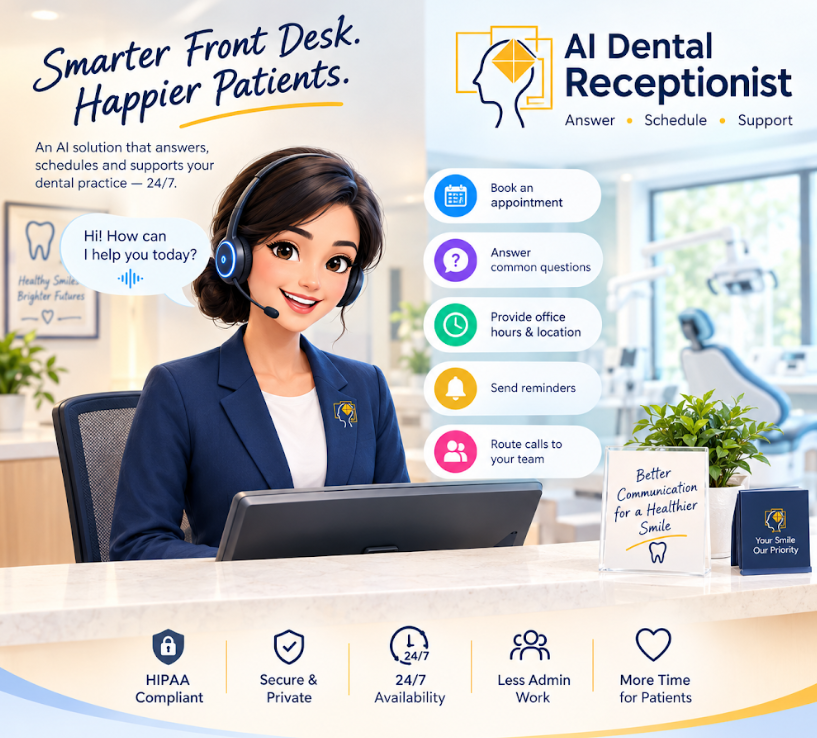
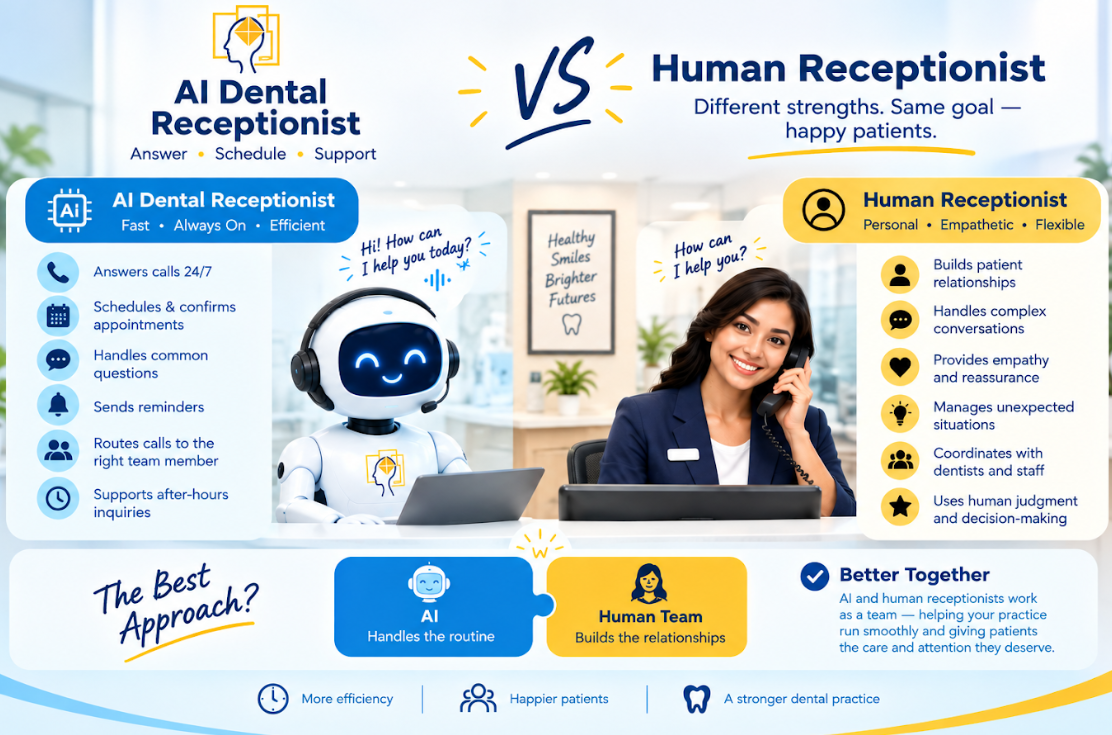
At TensorLinks, this is the exact progression we are building for front-office operations — an agent that does not just answer the phone, but watches the operation (missed calls, overdue patients, schedule gaps, no-show risk, incomplete follow-ups) and starts the right workflow before anyone asks, while the team stays in control. Reactive is table stakes now. Proactive is where the value lives.
Curious what a proactive operations agent would notice and act on in your business — before your team has to go looking? See TensorLinks run the front office across voice, text, and web.
Book a Demo →
Tags: AI agents, agentic AI, proactive AI, monitoring agents, multi-agent systems, AI infrastructure, OpenClaw, Claude Code, Codex, AI agent evolution 2026