
How many patient calls is your practice missing?
Most dental practices miss 30-40% of inbound calls. See how AI reception can capture every call 24/7.
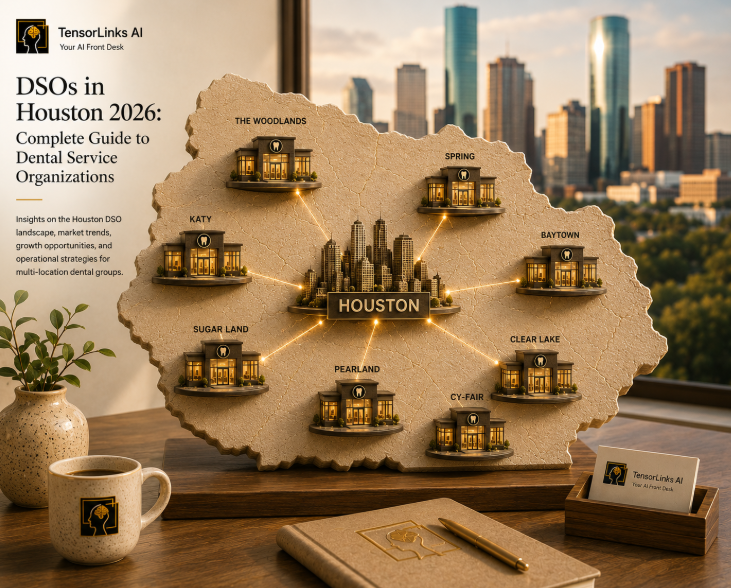
Houston is the largest dental market in Texas and one of the most diverse in the United States. With over 7 million residents in the metro, the Texas Medical Center as the largest medical complex in the world, and a multilingual patient population spanning Spanish, Vietnamese, Mandarin, and Arabic speakers, Houston represents both massive opportunity and unique operational complexity for Dental Service Organizations.
What is a DSO?
A Dental Service Organization (DSO) is a management company that provides non-clinical business services — HR, marketing, billing, IT, compliance, real estate, and centralized operations — for groups of dental practices. Dentists own the clinical entity (required under Texas's corporate practice of dentistry rules); the DSO partners through management services agreements to handle everything operational, freeing clinicians to focus on patient care while the DSO delivers scale.
The Houston DSO Market in 2026
Houston's DSO landscape is shaped by factors unique to the metro:
- Sheer scale: Greater Houston exceeds 7 million residents — the second-largest dental market in Texas after DFW. Houston added 43,217 net new residents between July 2023 and July 2024.
- Multilingual patient base: Spanish, Vietnamese, Mandarin, and Arabic populations all require dedicated language support. Houston has the largest Vietnamese-American community in the United States and one of the largest Latin American communities.
- Texas Medical Center anchor: the world's largest medical complex (120,000+ daily workforce) creates demand for medical-adjacent dental services, oral surgery, and high-acuity restorative care.
- Suburban growth corridors: Sugar Land, The Woodlands, Katy, Pearland, Cypress, and Spring are leading new-location expansion. The Woodlands and Sugar Land specifically have demographics that favor cosmetic and high-end restorative practices.
- Energy-sector employer base: oil & gas, petrochemical, and aerospace employers (Chevron, ExxonMobil, NASA, Halliburton) drive strong PPO insurance penetration with mature dental benefits.
- Hurricane-driven seasonality: emergency dental demand spikes in late summer and fall during hurricane recovery periods. Practices with strong front-desk resilience capture disproportionate share during these windows.
- Heavy DSO competition: Houston has been a primary target for DSO M&A activity over the past decade. New entrants compete for both established practice acquisitions and de novo locations in growth corridors.
Top DSOs Operating in Houston
Major DSOs with significant Houston metro presence include:
- Heartland Dental — extensive supported practice network across Greater Houston, with strong suburban concentration
- Pacific Dental Services — robust Houston suburban presence with technology-forward operations
- Aspen Dental — multiple metro locations focused on patient access and walk-in availability
- Western Dental & Orthodontics — orthodontic and pediatric expansion specifically targeting Houston growth corridors
- Smile Brands — Bright Now! Dental and affiliated practice network
- Affordable Care — denture and oral surgery DSO with Houston metro locations
- Smile Doctors — orthodontic DSO with active Texas presence
- Sage Dental — multi-location DSO with Texas operations
- Decision One Dental Partners — Texas-focused emerging DSO
- Mortenson Family Dental — regional DSO with Houston-area operations
Running a multi-location dental group in Houston? See how TensorLinks AI handles bilingual call volume across Greater Houston from one centralized platform.
Book a Demo →How AI Front Desk Solves Houston DSO Operational Pain
Houston DSOs face a combination of multilingual demand, scale, and operational resilience challenges that traditional front-desk staffing models struggle to handle. AI front desk technology addresses each:
- Multi-language call handling: 24+ languages with auto-detection — critical in Houston's diverse patient base. The AI detects Vietnamese, Spanish, Mandarin, or Arabic on the first syllable and switches seamlessly. No need to staff bilingual receptionists at every location or maintain separate phone lines per language.
- 24/7 coverage at scale: AI handles thousands of inbound calls across the metro without proportional staffing. A 20-clinic Houston DSO using TensorLinks captures the same call volume that would require ~30 full-time front-desk staff.
- Operational continuity: hurricane-season disruptions, staff shortages, and high-volume days don't take the front desk offline. AI is location-independent — it works whether the office is staffed or not.
- Insurance verification automation: reduces friction in Houston's heavy PPO market where eligibility checks for Aetna, Cigna, BCBS, MetLife, and Delta Dental are a primary front-desk time sink.
- Centralized multi-location management: Sugar Land + The Woodlands + Katy + Pearland schedules visible from one dashboard. Routing logic sends patients to the right office automatically.
- Recall and reactivation: reactivates lapsed patients across a sprawling metro with no manual outbound staffing. Houston practices typically have 30-50% lapsed-patient backlogs worth $150K-$500K in deferred revenue per location.
The Houston Bilingual Call Challenge
One of the most underappreciated dynamics in Houston's dental market is the cost of bilingual front-desk staffing. Most Houston DSOs struggle with one of two patterns:
- Pattern A — Staff bilingual receptionists at every location: works but is expensive ($45K-$60K/year per bilingual hire vs $35K-$45K for English-only) and creates staffing fragility when bilingual staff turn over
- Pattern B — Route Spanish callers to a central bilingual phone tree: creates patient friction (transferred calls, longer hold times, lower booking conversion) and damages NPS scores
AI front-desk technology eliminates this trade-off — every patient gets the same instant, bilingual response regardless of which location they call. The economics typically improve 8-15% on revenue per location once deployed.
Houston DSOs that haven't solved the bilingual front-desk equation are leaving 15-25% of patient revenue on the table — particularly in the Vietnamese, Spanish, and Mandarin patient segments.
Frequently Asked Questions
How many DSOs operate in the Houston metro?
Major national DSOs with Houston presence include Heartland Dental, Pacific Dental Services, Aspen Dental, Smile Brands, and Western Dental & Orthodontics. Texas-focused regional DSOs include Smile Doctors, Decision One Dental Partners, Sage Dental, and Mortenson Family Dental. The combined DSO footprint covers an estimated 200+ supported practices across Greater Houston.
What's the best Houston suburb for a new DSO location?
The fastest-growing suburbs in 2026 are Cypress, Pearland, and Katy, all with strong demographic and income trends. The Woodlands and Sugar Land are more saturated but remain attractive for cosmetic and high-end restorative DSOs given the higher household income demographics. The decision depends on the DSO's positioning — pediatric and ortho-focused DSOs do best in Katy and Cypress, while general-practice DSOs benefit from Sugar Land and The Woodlands.
How important is multilingual support for Houston dental DSOs?
Critical and underserved. Roughly 38% of Houston metro residents speak a language other than English at home — primarily Spanish, but also Vietnamese (Houston has the largest Vietnamese-American community in the US), Mandarin, and Arabic. DSOs that don't have native or AI-supported multilingual call handling lose meaningful market share to bilingual independent practices. AI front-desk platforms like TensorLinks handle 24+ languages automatically.
How does the Texas Medical Center affect Houston dental demand?
The Texas Medical Center is the world's largest medical complex with 120,000+ daily workforce and multiple top-tier hospitals (MD Anderson, Texas Children's, Memorial Hermann, Methodist, St. Luke's). It creates dense demand for: (1) dental services for the medical workforce, (2) medical-adjacent dental specialties like oral surgery and TMJ, and (3) post-treatment dental care for patients undergoing chemotherapy or radiation. DSOs with proximity or referral relationships to TMC have a meaningful demand advantage.
What's the typical front-desk turnover at a Houston dental DSO?
Industry averages run 35-45% annual turnover for front-desk staff at Houston-area DSOs, with bilingual staff at the higher end driven by competing demand from healthcare and energy-sector employers. The hidden cost is not just hiring and training — it's the missed-call revenue during transition periods when shifts go uncovered, particularly for bilingual capacity.
How does TensorLinks AI integrate with the PMS systems Houston DSOs use?
TensorLinks integrates with all major dental PMS systems used by Houston DSOs: Dentrix, Eaglesoft, Open Dental, Curve Dental, Denticon, and CareStack. The AI books appointments directly into the PMS in real time across all locations, with no manual entry or batch sync delay.
How resilient is AI front-desk technology to hurricane disruptions?
Highly resilient. Because the AI runs in the cloud and doesn't depend on any single physical location's staff or infrastructure, it continues handling calls even when individual offices are closed due to flooding, power outages, or staff displacement. During Hurricane Harvey-scale events, this is the difference between losing weeks of revenue and capturing the surge in emergency dental demand that follows recovery.
What's the biggest operational challenge for Houston DSOs in 2026?
Bilingual front-desk operations at scale: a combination of multi-language demand, sprawling metro geography, and tight labor competition from healthcare and energy employers makes traditional staffing models increasingly uneconomical. DSOs that adopt AI front-desk technology see measurable improvements in non-English-speaking patient capture, no-show reduction, and hygiene recall — typically with 8-15% revenue uplift per location in the first year.
Related Reading
- DSOs in Texas 2025: Complete State-Level Guide — broader Texas DSO landscape and regulatory context
- DSOs in Austin 2026 — sister-city analysis for Texas DSO operators
- DSOs in Dallas 2026 — North Texas DSO operations guide
- Dallas-Fort Worth Dental Market in 2026 — DFW market intelligence
- Multilingual AI Receptionist for Dental — implementation guide for non-English call handling
- 25-Clinic DSO Case Study: $180K Revenue Recovered — real numbers from a Texas-based DSO deployment
Texas-based and serving DSOs across Houston, Austin, and Dallas-Fort Worth. See how TensorLinks AI handles bilingual call volume, hurricane-resilient operations, and recall campaigns across Greater Houston from one centralized platform.
Book a Demo →Tags: DSOs in Houston, Houston dental service organizations, Houston DSO, Sugar Land dental, The Woodlands DSO, Katy dental, Pearland dental, Cypress dental, Houston dental market 2026, multi-location dental Houston, Texas DSO, bilingual dental Houston, Texas Medical Center dental
Related articles
More from DSO & Multi-Clinic on TensorLinks.
Case Study: How One Multi-Location DSO Increased Revenue by 22% Using TensorLinks
Discover how a 12-location DSO increased revenue by 22% in just 90 days using TensorLinks' AI-powered automation and real-time insights.
Why Every DSO Needs a Centralized Ops Dashboard
Managing multiple dental practices? Discover how a centralized dashboard can revolutionize your DSO operations.
DSOs in Texas 2025: Complete Guide to Dental Service Organizations
Comprehensive guide to Dental Service Organizations (DSOs) in Texas for 2025. Learn about the Texas DSO landscape, top organizations, market trends, and how AI is transforming dental practices across the Lone Star State.
DSOs in California 2025: Complete Guide to Dental Service Organizations
Comprehensive guide to Dental Service Organizations (DSOs) in California for 2025. Explore the California DSO landscape, major players, regulatory considerations, and how AI is reshaping dental practices in the Golden State.
Ready to stop missing patient calls?
TensorLinks AI answers every call 24/7, books appointments into your PMS, and speaks 24+ languages. Join hundreds of dental practices already using AI reception.