
How many patient calls is your practice missing?
Most dental practices miss 30-40% of inbound calls. See how AI reception can capture every call 24/7.
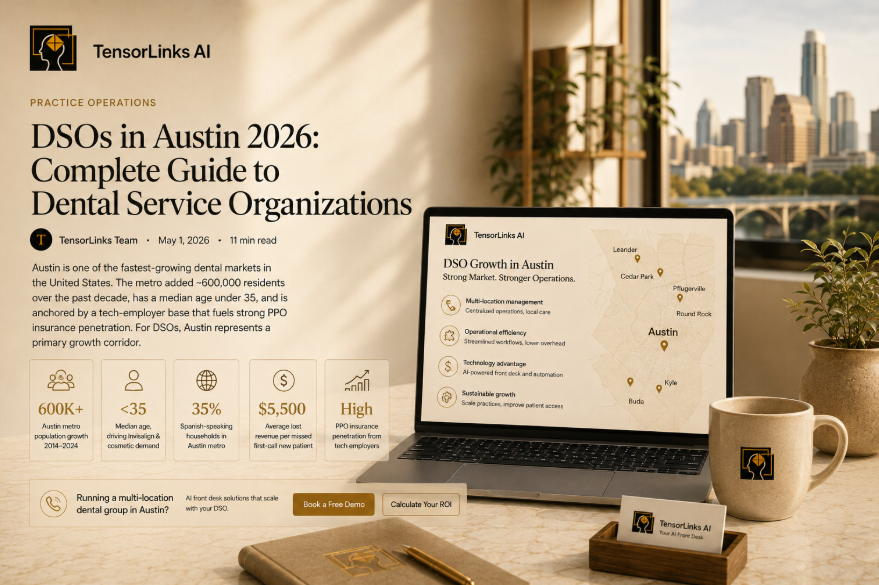
Austin is one of the fastest-growing dental markets in the United States. The metro added ~600,000 residents over the past decade, has a median age under 35, and is anchored by a tech-employer base — Tesla, Apple, Oracle, Indeed, Meta — that fuels strong PPO insurance penetration. For Dental Service Organizations, Austin represents a primary growth corridor where market dynamics favor disciplined operators with strong technology stacks.
What is a DSO?
A Dental Service Organization (DSO) is a management company that provides non-clinical business services — staffing, marketing, billing, IT, compliance, and centralized operations — to a network of dental practices. Dentists own the clinical practice; the DSO handles everything else, freeing clinicians to focus on patient care while the DSO delivers operational scale, capital, and growth infrastructure.
In Texas specifically, DSOs operate under strict corporate practice of dentistry (CPOD) rules that require licensed dentists to own the clinical entity — DSOs partner with those entities through management services agreements (MSAs) rather than owning the practice directly.
The Austin DSO Market in 2026
Austin's DSO landscape is shaped by factors unique to the metro:
- Explosive population growth: Austin metro added ~600,000 residents over the past decade, with continued migration from California, Chicago, and the Northeast. Practice owners are seeing patient counts grow without active acquisition spend.
- Young demographic mix: Median age under 35, driving high demand for orthodontics, cosmetic dentistry, and Invisalign rather than restorative-heavy care. Cosmetic and ortho-focused DSOs are expanding aggressively.
- Tech-employer benefits: Tesla, Apple, Oracle, Indeed, and Meta employees have strong dental benefits — creating a high-volume PPO market where billing operations and insurance verification become a primary bottleneck.
- Bilingual market: Roughly 35% of Austin metro residents speak Spanish at home. DSOs that can't handle Spanish-language calls at every location lose meaningful market share.
- Suburban sprawl: Round Rock, Cedar Park, Pflugerville, Leander, Kyle, and Buda represent the highest growth opportunities for new dental locations. DSOs are racing to lock down real estate in these corridors before saturation.
- Tight labor market: Austin's hourly wages have outpaced national averages — front-desk hiring is increasingly expensive and turnover is high.
Top DSOs Operating in Austin
Major DSOs with significant Austin metro presence include:
- Heartland Dental — the largest supported-practice network in the country with extensive Austin and suburban presence
- Pacific Dental Services — supports practices throughout Central Texas, with strong technology and operations infrastructure
- Smile Brands — operates Bright Now! Dental and affiliated practices across the metro
- Aspen Dental — multiple Austin metro locations focused on patient access and walk-in availability
- Western Dental & Orthodontics — orthodontic-focused expansion specifically targeting Texas markets
- Affordable Care — denture and oral surgery DSO with Austin-area locations serving the older demographic
- Smile Doctors — orthodontic DSO with strong Texas footprint, particularly in suburban growth corridors
- Sage Dental — emerging multi-location DSO with Texas operations
- Decision One Dental Partners — Texas-focused DSO with Austin presence
Running a multi-location dental group in Austin? See how TensorLinks AI handles call volume across the metro from one centralized platform.
Book a Demo →How AI Front Desk Solves Austin DSO Operational Pain
Austin DSOs face a unique combination of high call volume, bilingual demand, and labor competition from tech employers. AI front desk technology addresses each:
- 24/7 call coverage: tech-employer schedules drive after-hours and weekend call patterns. Engineers and product managers don't call dental offices at 10am — they call at 7pm after work or Saturday morning. AI captures every call regardless of time.
- Bilingual handling: 24+ languages with automatic detection eliminates the need to staff bilingual receptionists at every location. The AI detects Spanish on the first syllable and switches seamlessly.
- Operatory-aware scheduling: handles complex multi-location, multi-provider scheduling across the metro — books the right procedure with the right provider in the right operatory at the right Austin/Round Rock/Cedar Park office.
- Labor cost relief: Austin's tight labor market makes front-desk staff hiring expensive — Pacific Dental, Heartland, and Smile Brands have all reported front-desk turnover above 30%. AI complements existing teams rather than replacing them.
- Recall and reactivation: recovers the 30-50% of patients who lapse — a critical revenue lever in a market where new-patient acquisition costs continue to climb.
- Insurance verification automation: reduces friction in a heavy PPO market where eligibility checks are a primary front-desk time sink.
The Austin Tech-Employer Calling Pattern
One of the most underappreciated dynamics in Austin's dental market is the calling pattern of tech-sector patients. Unlike traditional 9-to-5 employees who call during business hours, Austin tech employees:
- Call after 6pm when their work day ends — when most dental practices are closing
- Call on weekends when dental practices are closed entirely
- Use chat and SMS as their preferred communication channel — voice is increasingly a fallback
- Expect immediate response — they live in a world of Slack notifications and Cursor autocomplete
For DSOs operating in Austin, this means after-hours and weekend call capture is disproportionately valuable. Practices that route after-hours calls to voicemail are systematically losing the highest-value demographic in the market.
The Austin tech-employer calling pattern means after-hours and weekend call capture is the single highest-leverage operational improvement for any DSO operating in the metro.
Frequently Asked Questions
How many DSOs operate in the Austin metro?
Major national DSOs with Austin presence include Heartland Dental, Pacific Dental Services, Aspen Dental, Smile Brands, and Western Dental & Orthodontics. Texas-focused regional DSOs include Smile Doctors, Decision One Dental Partners, and Sage Dental. The combined DSO footprint covers an estimated 100+ supported practices across Greater Austin.
What's the best Austin suburb for a new DSO location?
The fastest-growing suburbs in 2026 are Pflugerville, Leander, and Kyle, all with strong demographic and income trends. Round Rock and Cedar Park are more saturated but still have specific neighborhood pockets with limited dental coverage. The decision depends on the DSO's positioning — pediatric and ortho-focused DSOs do best in young-family suburbs like Pflugerville and Leander, while general-practice DSOs benefit from the higher-density established corridors.
How important is Spanish-language support for Austin dental DSOs?
Critical. Roughly 35% of Austin metro residents speak Spanish at home, with concentration in East Austin, North Austin, and Bastrop County. DSOs that don't have native or AI-supported Spanish call handling lose meaningful market share to bilingual independent practices. The good news: AI front-desk platforms like TensorLinks handle Spanish automatically with no separate phone line or staff training required.
What's the typical front-desk turnover at an Austin dental DSO?
Industry averages run 30-40% annual turnover for front-desk staff at Austin-area DSOs, driven by Austin's tight labor market and competitive hourly wages from tech employers, retail, and hospitality. The hidden cost is not just hiring and training — it's the missed-call revenue during transition periods when shifts go uncovered.
How does TensorLinks AI integrate with the PMS systems Austin DSOs use?
TensorLinks integrates with all major dental PMS systems used by Austin DSOs: Dentrix, Eaglesoft, Open Dental, Curve Dental, Denticon, and CareStack. The AI books appointments directly into the PMS in real time, with no manual entry or sync delay.
Is Austin a good market for opening a new dental DSO from scratch?
Yes, but with caveats. Population growth and demographic favorability are strong, but real estate costs are high and labor is competitive. The most successful new DSOs in Austin in recent years have either focused on a specialty (orthodontics, pediatric) where competition is lighter, or have leveraged AI front-desk and centralized operations to keep per-location overhead lower than traditional DSOs.
What's the biggest operational challenge for Austin DSOs in 2026?
Front-desk operations: a combination of after-hours and weekend call patterns from tech-sector patients, bilingual demand, and tight labor market makes traditional front-desk staffing models increasingly uneconomical. DSOs that adopt AI front-desk technology see measurable improvements in call answer rate, no-show reduction, and hygiene recall — typically with 8-12% revenue uplift in the first year.
Related Reading
- DSOs in Texas 2025: Complete State-Level Guide — broader Texas DSO landscape and regulatory context
- Dallas-Fort Worth Dental Market in 2026 — DFW market intelligence for DSO operators
- DSOs in Houston 2026 — sister-city analysis for Texas DSO operators
- DSOs in Dallas 2026 — North Texas DSO operations guide
- 25-Clinic DSO Case Study: $180K Revenue Recovered — real numbers from a Texas-based DSO deployment
Texas-based and serving DSOs across Austin, Houston, and Dallas-Fort Worth. See how TensorLinks AI handles call volume, bilingual scheduling, and recall campaigns across the metro from one centralized platform.
Book a Demo →Tags: DSOs in Austin, Austin dental service organizations, Austin DSO, Round Rock dental, Cedar Park DSO, Pflugerville dental, Leander DSO, Austin dental market 2026, multi-location dental Austin, Texas DSO, Heartland Dental Austin, Pacific Dental Austin
Related articles
More from DSO & Multi-Clinic on TensorLinks.
Case Study: How One Multi-Location DSO Increased Revenue by 22% Using TensorLinks
Discover how a 12-location DSO increased revenue by 22% in just 90 days using TensorLinks' AI-powered automation and real-time insights.
Why Every DSO Needs a Centralized Ops Dashboard
Managing multiple dental practices? Discover how a centralized dashboard can revolutionize your DSO operations.
DSOs in Texas 2025: Complete Guide to Dental Service Organizations
Comprehensive guide to Dental Service Organizations (DSOs) in Texas for 2025. Learn about the Texas DSO landscape, top organizations, market trends, and how AI is transforming dental practices across the Lone Star State.
DSOs in California 2025: Complete Guide to Dental Service Organizations
Comprehensive guide to Dental Service Organizations (DSOs) in California for 2025. Explore the California DSO landscape, major players, regulatory considerations, and how AI is reshaping dental practices in the Golden State.
Ready to stop missing patient calls?
TensorLinks AI answers every call 24/7, books appointments into your PMS, and speaks 24+ languages. Join hundreds of dental practices already using AI reception.