
How many patient calls is your practice missing?
Most dental practices miss 30-40% of inbound calls. See how AI reception can capture every call 24/7.
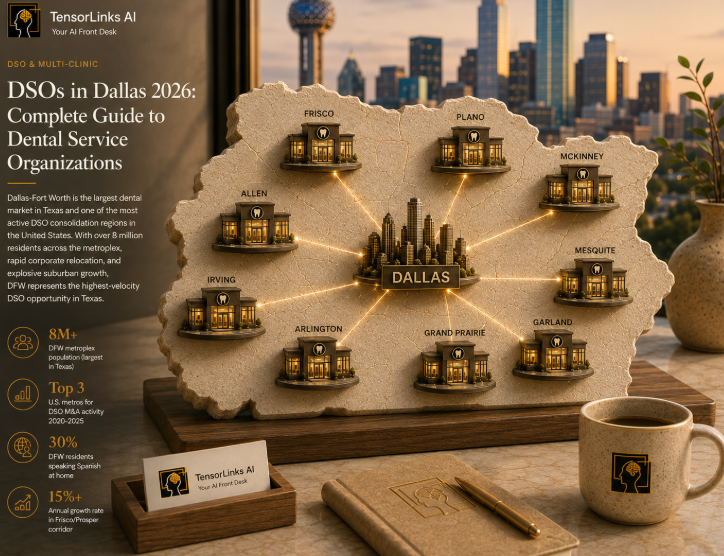
Dallas-Fort Worth is the largest dental market in Texas and one of the most active DSO consolidation regions in the United States. With over 8 million residents across the metroplex, rapid corporate relocation from California and the Northeast, and explosive suburban growth in Frisco, Plano, McKinney, and Allen, DFW represents the highest-velocity Dental Service Organization opportunity in Texas.
What is a DSO?
A Dental Service Organization (DSO) is a management company that provides operational services — staffing, marketing, billing, IT, compliance, and centralized infrastructure — to a network of dental practices. Under Texas's corporate practice of dentistry rules, dentists own the clinical entity; the DSO partners through management services agreements to deliver business scale and growth capital while clinicians focus on patient care.
The Dallas DSO Market in 2026
Dallas-Fort Worth's DSO landscape is shaped by factors unique to the metroplex:
- Explosive suburban growth: Frisco, Plano, McKinney, Allen, and Prosper are among the fastest-growing communities in the United States. DSOs are expanding aggressively in these corridors, with new-location announcements happening monthly.
- Corporate HQ migration: Toyota, Liberty Mutual, JPMorgan, and Caterpillar relocations have driven a wave of high-income, dental-benefits-rich households into North Dallas and Frisco. The relocations continue.
- Bilingual patient mix: 30% of DFW residents speak Spanish at home — bilingual front-desk operations are non-negotiable. The Spanish-speaking concentration is highest in Dallas, Garland, Irving, and Grand Prairie.
- Two anchor metros: Dallas and Fort Worth function as distinct submarkets with their own competitive dynamics. DSOs that succeed in both typically run them as separate market units.
- Heavy DSO consolidation: DFW has been a top-three U.S. metro for DSO M&A activity over the past five years. Independent practices are increasingly viewing DSO acquisition as the primary exit path.
- High Invisalign and cosmetic demand: affluent suburban demographics in Plano, Frisco, Westlake, and Highland Park drive demand for orthodontics, veneers, and high-end cosmetic dentistry.
- Healthcare-system convergence: Baylor Scott & White, UT Southwestern, and Texas Health Resources all have growing dental and oral health programs that interact with DSO market dynamics.
Top DSOs Operating in Dallas-Fort Worth
Major DSOs with significant DFW presence include:
- Heartland Dental — large supported practice network across the metroplex with strong Plano, Frisco, and Arlington footprint
- Pacific Dental Services — strong Dallas and Fort Worth suburban presence with technology-forward operations
- Smile Brands — Bright Now! Dental and affiliated practices across DFW
- Aspen Dental — multiple metroplex locations focused on patient access and walk-in availability
- Western Dental & Orthodontics — orthodontic-focused growth specifically targeting DFW suburbs
- Smile Doctors — orthodontic DSO with strong Texas footprint and Dallas-area HQ
- Affordable Care — denture and oral surgery DSO with DFW locations
- Decision One Dental Partners — emerging Texas-focused DSO with active DFW expansion
- Sage Dental — multi-location DSO expanding in Texas
- MB2 Dental — Carrollton-headquartered partnership-model DSO with strong DFW presence
- Mortenson Family Dental — regional DSO with DFW operations
Running a multi-location dental group in Dallas-Fort Worth? See how TensorLinks AI handles call volume across the metroplex from one centralized platform.
Book a Demo →How AI Front Desk Solves DFW DSO Operational Pain
Dallas-Fort Worth DSOs face a combination of bilingual demand, suburban-sprawl scheduling, and labor cost pressure. AI front desk technology addresses each:
- Multi-location, multi-submarket scheduling: AI manages schedules across Dallas, Fort Worth, Plano, Frisco, McKinney, Arlington, Mansfield, and beyond from one platform — with location-routing logic that sends patients to the right office automatically.
- 24/7 bilingual call handling: Spanish + English with automatic detection — essential in DFW's demographic mix. The AI detects the caller's language on the first syllable and switches seamlessly without staff intervention.
- Insurance verification automation: high PPO penetration in DFW (driven by corporate HQ relocations) means insurance friction is a primary front-desk bottleneck. AI handles eligibility checks for all major carriers in real time.
- Recall and reactivation at scale: recovers lapsed patients across a metroplex too large to call manually. A typical 15-clinic DFW DSO has $1M-$3M in lapsed-patient revenue waiting to be reactivated.
- Tight-labor-market relief: DFW front-desk hiring is increasingly expensive — corporate HQ relocations and growth in tech, financial services, and healthcare all compete for the same labor pool. AI complements existing teams without adding headcount.
- Centralized DSO command center: visibility into call volume, booking rate, and missed-call recovery by location — critical for DSO leaders managing 10+ practices across the metroplex.
The DFW Suburban-Sprawl Scheduling Problem
One of the most underappreciated operational challenges in DFW dental is the sheer geographic complexity of the metroplex. A typical 20-clinic DFW DSO might have:
- Locations spanning Dallas, Fort Worth, Plano, Frisco, McKinney, Arlington, Mansfield, Garland, Irving, and beyond
- Patients who move between suburbs as they relocate within the metroplex
- Specialty providers (oral surgery, ortho, perio) at specific locations only
- Operatory and equipment differences (panoramic, CBCT, Itero) by location
- Different insurance contract status by location and provider
Manual front-desk staff at each location can't see the full picture. They don't know which sister-location has earlier availability, which office has the right specialist, or which has the operatory equipment a patient needs. AI front-desk technology solves this by maintaining a centralized view of all locations, providers, and capabilities — and routing each call to the optimal office.
The DFW suburban-sprawl scheduling problem is the single biggest operational drag on multi-location DSO economics. AI front-desk is the only practical solution at scale.
Frequently Asked Questions
How many DSOs operate in the Dallas-Fort Worth metroplex?
Major national DSOs with DFW presence include Heartland Dental, Pacific Dental Services, Aspen Dental, Smile Brands, and Western Dental & Orthodontics. DFW-headquartered or Texas-focused regional DSOs include Smile Doctors, MB2 Dental (Carrollton), Decision One Dental Partners, Sage Dental, and Mortenson Family Dental. The combined DSO footprint covers an estimated 250+ supported practices across the metroplex — the largest DSO concentration in Texas.
Why is DFW such an active DSO M&A market?
Three factors: (1) demographics favor consolidation — high population growth, affluent suburbs, and corporate relocations create attractive practice acquisition targets, (2) Texas's corporate practice of dentistry rules are well-established, giving DSOs operational predictability, and (3) DFW has a deep base of independent practices with retiring owners looking for exit paths, particularly in the 50-mile radius around Dallas. The combination has made DFW a top-three U.S. metro for DSO M&A activity over the past five years.
What's the best DFW suburb for a new DSO location?
The fastest-growing corridors in 2026 are Prosper, Celina, Anna, and Princeton (all north of Frisco/McKinney) and Heath/Rockwall (east of Dallas). Frisco, Plano, and McKinney are saturated but specific neighborhood pockets still have under-served dental coverage. Westlake and Southlake remain strong for high-end cosmetic and specialty practices. The decision depends on the DSO's positioning and target patient demographic.
How important is Spanish-language support for DFW dental DSOs?
Critical. 30% of DFW residents speak Spanish at home, with concentration in Dallas, Irving, Garland, Grand Prairie, and parts of Fort Worth. DSOs that don't have native or AI-supported Spanish call handling lose meaningful market share to bilingual independent practices. AI front-desk platforms handle Spanish automatically with no separate phone line, no extra hire, and no staff training required.
How does TensorLinks AI integrate with the PMS systems DFW DSOs use?
TensorLinks integrates with all major dental PMS systems used by DFW DSOs: Dentrix, Eaglesoft, Open Dental, Curve Dental, Denticon, and CareStack. The AI books appointments directly into the PMS in real time across all locations, with no manual entry or batch sync delay.
What's the typical front-desk turnover at a DFW dental DSO?
Industry averages run 30-40% annual turnover for front-desk staff at DFW-area DSOs, driven by corporate HQ relocations and competing demand from financial services, healthcare, and technology employers. The hidden cost is not just hiring and training — it's the missed-call revenue during transition periods, particularly for locations near corporate campuses where front-desk staff have the most outside options.
How does the DFW corporate HQ migration affect dental practice acquisition strategy?
The corporate HQ migration (Toyota, Liberty Mutual, JPMorgan, Caterpillar) has created concentrated wealth corridors in Plano, Frisco, Westlake, and parts of Las Colinas. DSOs targeting these corridors have shifted toward higher-end positioning — Invisalign, veneers, implants, and concierge dental — rather than commodity general dentistry. New-location underwriting now emphasizes household-income demographics over raw population growth.
What's the biggest operational challenge for DFW DSOs in 2026?
Multi-location, multi-submarket scheduling complexity: the geographic sprawl of DFW combined with the diversity of patient demographics means traditional location-by-location front-desk staffing creates operational drag and missed revenue. DSOs that adopt AI front-desk technology with centralized routing see measurable improvements in call answer rate, no-show reduction, hygiene recall, and bilingual-patient capture — typically with 8-12% revenue uplift per location in the first year.
Related Reading
- DSOs in Texas 2025: Complete State-Level Guide — broader Texas DSO landscape and regulatory context
- Dallas-Fort Worth Dental Market in 2026 — DFW market intelligence and growth corridors
- DSOs in Austin 2026 — sister-city analysis for Texas DSO operators
- DSOs in Houston 2026 — South Texas DSO operations guide
- Multilingual AI Receptionist for Dental — implementation guide for non-English call handling
- 25-Clinic DSO Case Study: $180K Revenue Recovered — real numbers from a Texas-based DSO deployment
Texas-based and serving DSOs across Dallas-Fort Worth, Houston, and Austin. See how TensorLinks AI handles bilingual call volume, multi-submarket scheduling, and recall campaigns across the DFW metroplex from one centralized platform.
Book a Demo →Tags: DSOs in Dallas, Dallas dental service organizations, DFW DSO, Plano dental, Frisco DSO, Fort Worth dental, McKinney dental, Arlington dental, Garland dental, Irving dental, Dallas dental market 2026, multi-location dental DFW, Texas DSO, North Texas dental, MB2 Dental Carrollton
Related articles
More from DSO & Multi-Clinic on TensorLinks.
Case Study: How One Multi-Location DSO Increased Revenue by 22% Using TensorLinks
Discover how a 12-location DSO increased revenue by 22% in just 90 days using TensorLinks' AI-powered automation and real-time insights.
Why Every DSO Needs a Centralized Ops Dashboard
Managing multiple dental practices? Discover how a centralized dashboard can revolutionize your DSO operations.
DSOs in Texas 2025: Complete Guide to Dental Service Organizations
Comprehensive guide to Dental Service Organizations (DSOs) in Texas for 2025. Learn about the Texas DSO landscape, top organizations, market trends, and how AI is transforming dental practices across the Lone Star State.
DSOs in California 2025: Complete Guide to Dental Service Organizations
Comprehensive guide to Dental Service Organizations (DSOs) in California for 2025. Explore the California DSO landscape, major players, regulatory considerations, and how AI is reshaping dental practices in the Golden State.
Ready to stop missing patient calls?
TensorLinks AI answers every call 24/7, books appointments into your PMS, and speaks 24+ languages. Join hundreds of dental practices already using AI reception.