
How many patient calls is your practice missing?
Most dental practices miss 30-40% of inbound calls. See how AI reception can capture every call 24/7.
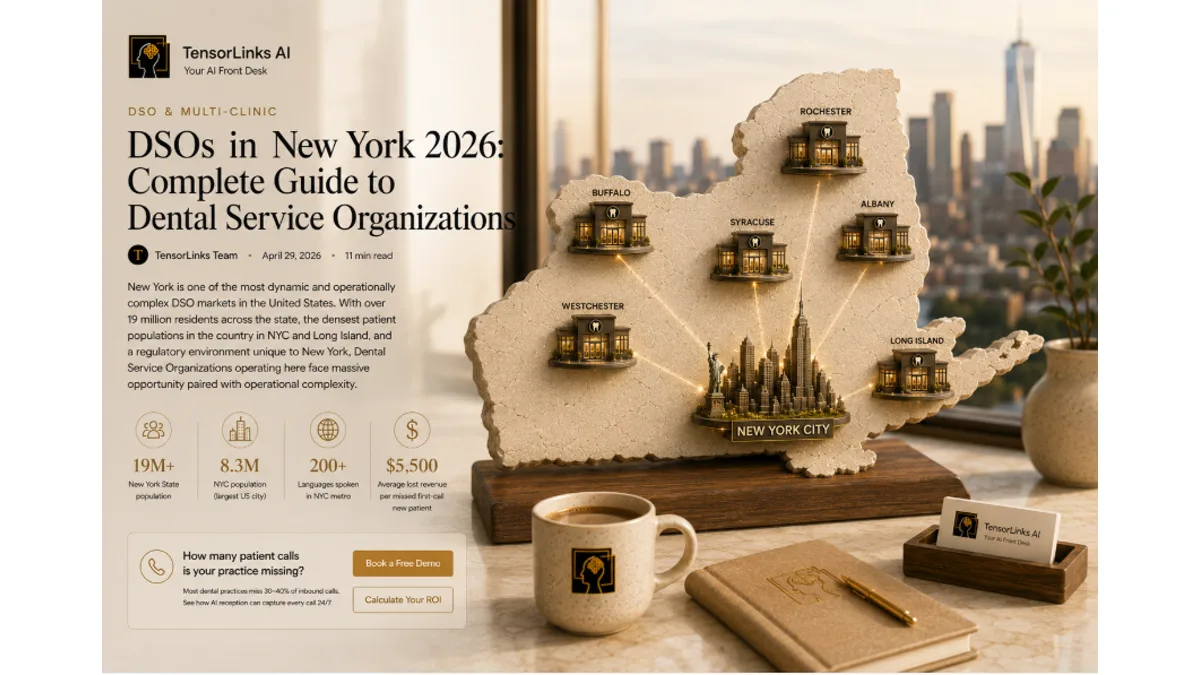
New York is one of the most dynamic and operationally complex DSO markets in the United States. With over 19 million residents across the state, the densest patient populations in the country in NYC and Long Island, and a regulatory environment unique to New York, Dental Service Organizations operating here face massive opportunity paired with operational complexity that doesn't exist in most other markets.
What is a DSO?
A Dental Service Organization (DSO) is a management company that provides non-clinical business services — staffing, marketing, billing, IT, compliance, real estate — to a network of dental practices. New York's corporate practice of dentistry rules require licensed dentists to own the clinical entity, so DSOs partner through management services agreements (MSAs) rather than owning practices directly. This structural reality shapes everything about how DSOs operate in New York.
The New York DSO Market in 2026
New York's DSO landscape is shaped by state-specific factors that don't apply elsewhere:
- Dense urban concentration: NYC, Long Island, Westchester, Buffalo, Rochester, and Albany metros concentrate patient demand. NYC alone has 8.3 million residents — practices serve more patients per square mile than anywhere else in the United States.
- High operational costs: Real estate, labor, and compliance costs are among the highest in the country. A front-desk hire in Manhattan can cost 60-80% more than the same role in upstate New York. Operational efficiency through technology is not optional — it's the only way the unit economics work.
- Multilingual patient bases: NYC alone has residents speaking 200+ languages — Spanish, Mandarin, Cantonese, Russian, Korean, Bengali, Haitian Creole, Yiddish, Polish, and Arabic are all major patient segments. DSOs that can't handle non-English calls at every location lose meaningful market share.
- Regulatory complexity: New York State has stringent corporate practice of dentistry rules. The Office of the Professions monitors DSO-clinical entity relationships closely. Compliance overhead is meaningful and ongoing.
- Insurance mix: Heavy commercial insurance presence (Aetna, Cigna, BCBS, Delta, MetLife) plus Medicaid Managed Care (Healthfirst, Fidelis, MetroPlus, EmblemHealth) creates verification complexity. Each Medicaid plan has different rules for dental coverage.
- Borough-level submarkets: Manhattan, Brooklyn, Queens, Bronx, and Staten Island function as distinct submarkets with different demographics, payer mixes, and competitive dynamics.
- Long Island and Westchester premium markets: high-income suburban patients with strong dental benefits drive demand for cosmetic, orthodontic, and high-end restorative care.
Top DSOs Operating in New York
Major DSOs with significant New York presence include:
- Heartland Dental — operates supported practices across NY metros, with significant Long Island and Westchester presence
- Aspen Dental — multiple New York locations focused on patient access and walk-in availability
- Pacific Dental Services — supports private practices across New York suburbs with technology-forward operations
- Smile Brands — Bright Now! Dental and other affiliated practices
- Dental Care Alliance — supports multiple New York group practices, particularly in upstate markets
- Mortenson Family Dental — regional DSO with NY operations
- Western Dental & Orthodontics — expanding presence in New York metros, particularly orthodontic-focused
- Specialty Dental Brands — orthodontic and pediatric DSO networks
- Sage Dental — multi-location DSO with selective NY presence
- Smile Doctors — orthodontic DSO with growing NY metro footprint
Running a multi-location dental group in New York? See how TensorLinks AI handles multilingual call volume across NYC, Long Island, and upstate from one centralized platform.
Book a Demo →How AI Front Desk Solves NY DSO Operational Pain
New York DSOs face a combination of multilingual demand, high labor costs, and complex insurance verification that traditional front-desk staffing models can't economically handle. AI front desk technology addresses each:
- 24/7 call coverage: NYC dental practices receive calls across all time zones from international patients, shift workers, and after-hours residents. AI captures every call regardless of time of day.
- 24+ languages with auto-detection: the AI detects the caller's language on the first syllable and switches seamlessly. Eliminates the need to staff bilingual receptionists at every NY location — particularly valuable in Queens, Brooklyn, and the Bronx where 40-60% of calls may be non-English.
- Operatory-aware scheduling: books the right procedure with the right provider in the right operatory across complex multi-location, multi-borough schedules.
- Insurance verification automation: real-time eligibility checks reduce front-desk burden in NY's complex payer environment, including Medicaid Managed Care plans.
- Recall and reactivation campaigns: recover the 30-50% of patients who lapse — particularly valuable in NY's high-cost market where each reactivated patient has outsized economic impact.
- Cost-per-location relief: a Manhattan front-desk hire costs $55K-$80K with benefits. AI handles 24/7 coverage at a fraction of the cost across all locations simultaneously.
The NY Multilingual Operational Reality
NYC's multilingual market isn't just "Spanish support" — it's genuinely multilingual operations at scale. A Queens dental practice might receive calls in 8+ languages on any given day. Most DSO playbooks were built for English-primary markets and treat multilingual capability as an add-on. In NYC, that's a competitive disadvantage:
- Brooklyn: Spanish, Russian, Polish, Yiddish, Mandarin, Cantonese
- Queens: Spanish, Mandarin, Bengali, Korean, Punjabi, Tagalog
- Bronx: Spanish (largest), Bengali, Albanian, Arabic
- Manhattan: Spanish, French, Mandarin, Russian, Korean
Staffing bilingual receptionists for each language at every location is operationally and economically impossible. AI front-desk platforms that handle 24+ languages natively are the only practical solution at NY's scale.
NYC's true multilingual reality — 200+ languages spoken, with 40-60% of calls non-English in many boroughs — means AI front-desk isn't a nice-to-have. It's the only economically viable way to operate.
Frequently Asked Questions
How many DSOs operate in New York State?
Major national DSOs with NY presence include Heartland Dental, Aspen Dental, Pacific Dental Services, Smile Brands, and Western Dental & Orthodontics. Regional DSOs include Dental Care Alliance, Mortenson Family Dental, Specialty Dental Brands, Sage Dental, and Smile Doctors. The combined DSO footprint covers an estimated 250+ supported practices across the state, with concentration in NYC metro and Long Island.
What's unique about New York's corporate practice of dentistry rules?
New York requires licensed dentists to own the clinical entity that delivers patient care. DSOs cannot directly own clinical practices — they partner through management services agreements (MSAs) that handle non-clinical operations (HR, marketing, billing, IT, real estate). The Office of the Professions monitors these arrangements. The structural reality means New York DSOs are typically more compliance-overhead-heavy than DSOs in other states.
What's the best NY metro for a new DSO location?
The fastest-growing corridors in 2026 are Long Island (Nassau and Suffolk Counties), Westchester County, and parts of Brooklyn and Queens experiencing gentrification. Upstate metros like Albany, Saratoga Springs, and Rochester are more affordable but have lower revenue ceilings. The decision depends on the DSO's positioning — high-end cosmetic and orthodontic DSOs do well in Long Island and Manhattan, while general-practice DSOs benefit from outer-borough density and Medicaid Managed Care patient volume.
How important is multilingual support for NY dental DSOs?
Critical and underserved. NYC alone has residents speaking 200+ languages. Spanish, Mandarin, Russian, Bengali, Korean, Yiddish, and Haitian Creole are all major patient segments. DSOs that don't have native or AI-supported multilingual call handling lose meaningful market share to bilingual independent practices. AI front-desk platforms like TensorLinks handle 24+ languages automatically.
What's the typical front-desk turnover at a NY dental DSO?
Industry averages run 35-50% annual turnover for front-desk staff at NY-area DSOs, driven by NYC's high cost of living, competing demand from healthcare and hospitality employers, and the high stress of front-desk work in dense urban environments. The hidden cost is not just hiring — it's the missed-call revenue during transition periods.
How does TensorLinks AI integrate with the PMS systems NY DSOs use?
TensorLinks integrates with all major dental PMS systems used by New York DSOs: Dentrix, Eaglesoft, Open Dental, Curve Dental, Denticon, and CareStack. The AI books appointments directly into the PMS in real time across all locations.
How does NY's Medicaid Managed Care complexity affect DSO operations?
NY Medicaid Managed Care plans (Healthfirst, Fidelis, MetroPlus, EmblemHealth, and others) each have different dental coverage rules, prior authorization requirements, and provider participation criteria. DSOs serving outer-borough or upstate patient bases need workflows for each plan. AI insurance verification dramatically reduces the front-desk time required to handle this complexity.
What's the biggest operational challenge for NY DSOs in 2026?
Multilingual front-desk operations at scale combined with high labor costs. The combination makes traditional staffing models economically unworkable for many NY DSOs. DSOs that adopt AI front-desk technology see measurable improvements in non-English call capture, no-show reduction, hygiene recall, and per-location operating margin — typically with 10-15% revenue uplift in the first year.
Related Reading
- DSOs in Pennsylvania 2026 — neighboring Mid-Atlantic DSO market
- DSOs in Ohio 2026 — Midwest DSO operations comparison
- DSOs in Illinois 2026 — Chicago metro DSO landscape
- Multilingual AI Receptionist for Dental — implementation guide
- 25-Clinic DSO Case Study: $180K Revenue Recovered — real DSO deployment numbers
Running a multi-location dental group in New York? See how TensorLinks AI handles multilingual call volume across NYC boroughs, Long Island, Westchester, and upstate from one centralized platform.
Book a Demo →Tags: DSOs in New York, NY dental service organizations, NYC DSO, Long Island dental, Buffalo dental practices, Brooklyn dental, Queens dental DSO, Bronx dental, Westchester DSO, New York dental market 2026, multi-location dental NY, NYC multilingual dental, NY Medicaid Managed Care dental
Related articles
More from DSO & Multi-Clinic on TensorLinks.
Case Study: How One Multi-Location DSO Increased Revenue by 22% Using TensorLinks
Discover how a 12-location DSO increased revenue by 22% in just 90 days using TensorLinks' AI-powered automation and real-time insights.
Why Every DSO Needs a Centralized Ops Dashboard
Managing multiple dental practices? Discover how a centralized dashboard can revolutionize your DSO operations.
DSOs in Texas 2025: Complete Guide to Dental Service Organizations
Comprehensive guide to Dental Service Organizations (DSOs) in Texas for 2025. Learn about the Texas DSO landscape, top organizations, market trends, and how AI is transforming dental practices across the Lone Star State.
DSOs in California 2025: Complete Guide to Dental Service Organizations
Comprehensive guide to Dental Service Organizations (DSOs) in California for 2025. Explore the California DSO landscape, major players, regulatory considerations, and how AI is reshaping dental practices in the Golden State.
Ready to stop missing patient calls?
TensorLinks AI answers every call 24/7, books appointments into your PMS, and speaks 24+ languages. Join hundreds of dental practices already using AI reception.