
How many patient calls is your practice missing?
Most dental practices miss 30-40% of inbound calls. See how AI reception can capture every call 24/7.
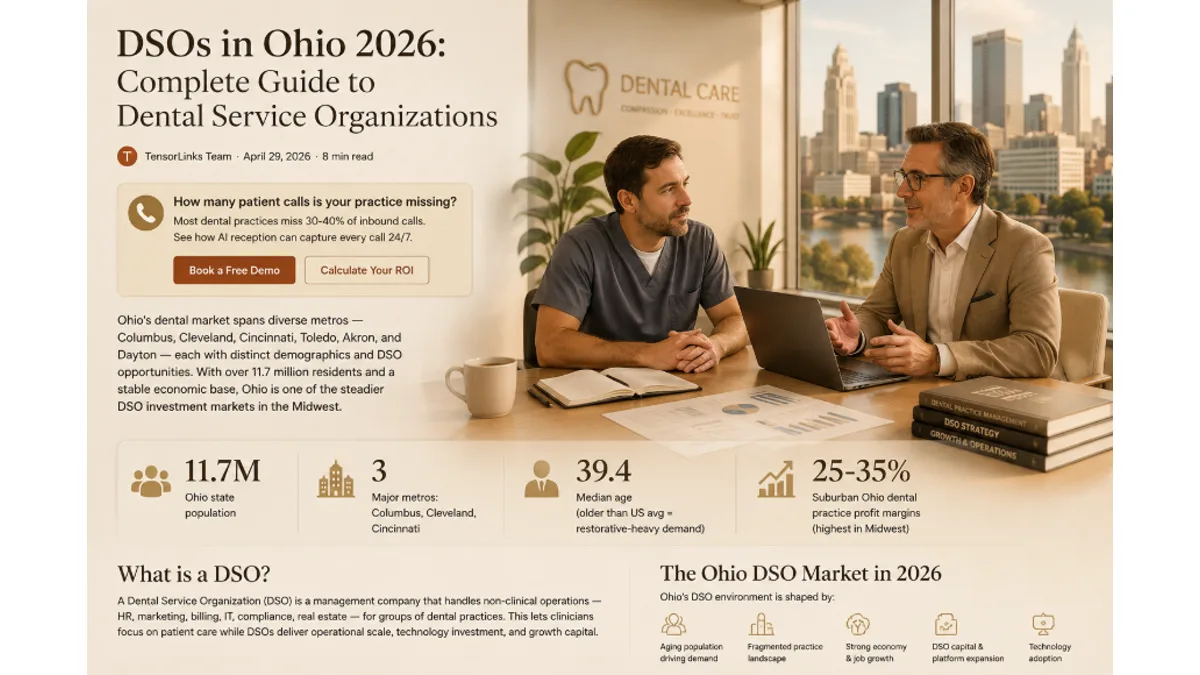
Ohio's dental market spans diverse metros — Columbus, Cleveland, Cincinnati, Toledo, Akron, and Dayton — each with distinct demographics and DSO opportunities. With over 11.7 million residents and a stable economic base, Ohio is one of the steadier DSO investment markets in the Midwest.
What is a DSO?
A Dental Service Organization (DSO) is a management company that handles non-clinical operations — HR, marketing, billing, IT, compliance, real estate — for groups of dental practices. This lets clinicians focus on patient care while DSOs deliver operational scale, technology investment, and growth capital.
The Ohio DSO Market in 2026
Ohio's DSO environment is shaped by:
- Three major metros: Columbus (state capital, fastest-growing), Cleveland (medical hub anchored by Cleveland Clinic), and Cincinnati (Tri-State market spanning OH, KY, IN) each host significant DSO activity with distinct competitive dynamics
- Stable, older patient demographics: Ohio's median age (39.4) is older than the US average, creating consistent demand for restorative, prosthodontic, and implant procedures rather than purely cosmetic. This favors general-practice DSOs over ortho-focused operators.
- Lower operating costs: Real estate and labor are 30-40% more affordable than coastal markets, materially improving DSO unit economics. A Cleveland front-desk hire costs ~$35K vs ~$55K in Manhattan.
- Established healthcare infrastructure: Cleveland Clinic, OSU Wexner Medical Center, Cincinnati Children's, and Ohio State College of Dentistry create strong dental ecosystem and referral networks
- Medicaid expansion impact: Ohio's Medicaid expansion increased dental access and DSO patient volume, particularly for general-practice DSOs serving lower-income corridors
- Strong suburban margins: Suburban Columbus, Cleveland, and Cincinnati practices report 25-35% profit margins — highest in the Midwest — making suburban DSO expansion particularly attractive
- Growth corridors: Columbus's Dublin, Westerville, and New Albany; Cleveland's Westlake and Avon; Cincinnati's Mason and West Chester are leading expansion areas
Top DSOs Operating in Ohio
- Heartland Dental — significant Ohio footprint across Columbus, Cleveland, and Cincinnati metros
- Aspen Dental — multiple Ohio locations focused on accessibility and walk-in availability
- North American Dental Group (NADG) — Pittsburgh-based DSO with significant Ohio expansion, particularly northeast Ohio
- Mortenson Family Dental — regional DSO with Ohio practices
- Pacific Dental Services — supported private practices in Ohio metros with technology-forward operations
- DECA Dental Group — Cleveland-area presence with growing footprint
- Smile Brands — affiliated practices across Ohio
- Western Dental & Orthodontics — expanding Ohio market presence
- Dental Care Alliance — supports Ohio group practices
- Smile Doctors — orthodontic DSO with Ohio expansion
Operating multiple dental practices across Ohio? See how TensorLinks AI handles call volume across Columbus, Cleveland, and Cincinnati from one dashboard.
Book a Demo →How AI Front Desk Helps Ohio DSOs
Ohio DSOs benefit from AI front desk technology in specific ways:
- Multi-metro coordination: one platform manages call routing across Columbus, Cleveland, Cincinnati simultaneously — with location-routing logic sending patients to the closest office
- After-hours coverage: catches calls during the 47% of dental call volume that happens outside business hours (Peerlogic 2026 industry data)
- Insurance verification: automates Medicaid Managed Care eligibility checks at scale — particularly valuable for Ohio's expanded Medicaid population
- Recall automation: recovers lapsed patients across Ohio's older population, where 6-18 month lapses are common and represent meaningful restorative revenue when reactivated
- PMS-agnostic: works across mixed Dentrix/EagleSoft/Open Dental environments common in DSO roll-up acquisitions
- Centralized DSO command center: visibility into call volume, booking rate, and missed-call recovery by location across all three Ohio metros
The Ohio Older-Population Restorative Opportunity
Ohio's median age of 39.4 (vs US median of 38.9) might sound marginal, but it has real operational implications for DSO economics:
- Higher restorative case mix: Crown, bridge, denture, and implant volume per practice runs 20-30% above national average
- Higher per-patient revenue: restorative cases average $1,500-$5,000 vs ~$300 for hygiene visits
- Longer treatment plans: phased restorative treatment plans extend patient relationships and lifetime value
- Recall criticality: older patients with completed restorative work need disciplined recall to maintain — a recall miss is a high-cost loss
For Ohio DSOs, the operational priority is recall execution and treatment-plan follow-through. AI outbound recall campaigns address both — without proportional staffing growth.
Ohio's older patient demographics make recall execution the single highest-leverage operational improvement for any DSO operating in the state — and AI outbound is the only practical way to do it at scale.
Frequently Asked Questions
How many DSOs operate in Ohio?
Major DSOs with Ohio presence include Heartland Dental, Aspen Dental, NADG, Pacific Dental Services, Mortenson Family Dental, Smile Brands, and Western Dental & Orthodontics. Regional DSOs include DECA Dental Group, Dental Care Alliance, and Smile Doctors. The combined DSO footprint covers an estimated 200+ supported practices across the state, with concentration in Columbus, Cleveland, and Cincinnati metros.
What's the best Ohio metro for a new DSO location?
Columbus is the fastest-growing metro and has the most favorable demographics for new DSO entry. Suburbs like Dublin, Westerville, New Albany, and Powell have strong household income and demographic trends. Cleveland's Westlake, Avon, and Solon are attractive for established suburban positioning. Cincinnati's Mason and West Chester offer suburban growth with proximity to corporate employers.
How does Ohio's older population affect DSO operations?
Ohio's median age (39.4) is slightly older than the US average, which has real DSO implications: higher restorative and prosthodontic case mix per practice, higher per-patient revenue from crown/bridge/denture/implant work, and greater importance of disciplined recall execution. DSOs that excel at recall and treatment-plan follow-through outperform peers in Ohio.
How does TensorLinks AI integrate with the PMS systems Ohio DSOs use?
TensorLinks integrates with all major dental PMS systems used by Ohio DSOs: Dentrix, Eaglesoft, Open Dental, Curve Dental, Denticon, and CareStack. The AI books appointments directly into the PMS in real time across all locations.
What's the typical front-desk turnover at an Ohio dental DSO?
Industry averages run 25-35% annual turnover for front-desk staff at Ohio-area DSOs, lower than coastal markets but still meaningful. Ohio's tighter labor market in healthcare and tech-adjacent sectors creates competing demand for front-desk talent. The hidden cost is the missed-call revenue during transition periods.
Is Ohio a good market for a first-time DSO investment?
Yes, particularly for operators positioning in general practice and restorative-heavy specialties. Ohio's combination of stable demographics, lower operating costs, and strong suburban margins makes it operationally attractive for DSOs that don't need explosive Sunbelt-style growth. The trade-off versus Texas or Florida is slower growth but more predictable unit economics.
How does Ohio's Medicaid expansion affect DSO patient mix?
Ohio's Medicaid expansion increased dental access for ~700,000 additional residents. For DSOs, this creates a meaningful patient volume opportunity in lower-income corridors — particularly in Cleveland, Dayton, and Toledo. The operational requirement is strong Medicaid Managed Care verification workflows, which AI front-desk handles natively.
What's the biggest operational challenge for Ohio DSOs in 2026?
Recall execution and treatment-plan follow-through across an older patient base. Traditional manual outbound recall doesn't scale, and DSOs that depend on it leave significant restorative revenue on the table. AI outbound recall campaigns address this — typically with 8-12% revenue uplift per location in the first year.
Related Reading
- DSOs in Pennsylvania 2026 — neighboring Mid-Atlantic DSO market
- DSOs in Illinois 2026 — Midwest DSO comparison
- DSOs in New York 2026 — Northeast DSO operations
- Proactive AI Outbound for Dental — recall execution playbook
- 25-Clinic DSO Case Study: $180K Revenue Recovered — real DSO deployment numbers
Operating dental practices across Ohio? TensorLinks AI handles call volume, recall execution, and patient communication across Columbus, Cleveland, and Cincinnati from one centralized dashboard.
Book a Demo →Tags: DSOs in Ohio, Ohio dental service organizations, Columbus DSO, Cleveland dental, Cincinnati dental practices, Dublin OH dental, Westerville DSO, Ohio dental market 2026, multi-location dental Ohio, NADG Ohio, DECA Dental Group, restorative dental Ohio, Ohio Medicaid dental
Related articles
More from DSO & Multi-Clinic on TensorLinks.
Case Study: How One Multi-Location DSO Increased Revenue by 22% Using TensorLinks
Discover how a 12-location DSO increased revenue by 22% in just 90 days using TensorLinks' AI-powered automation and real-time insights.
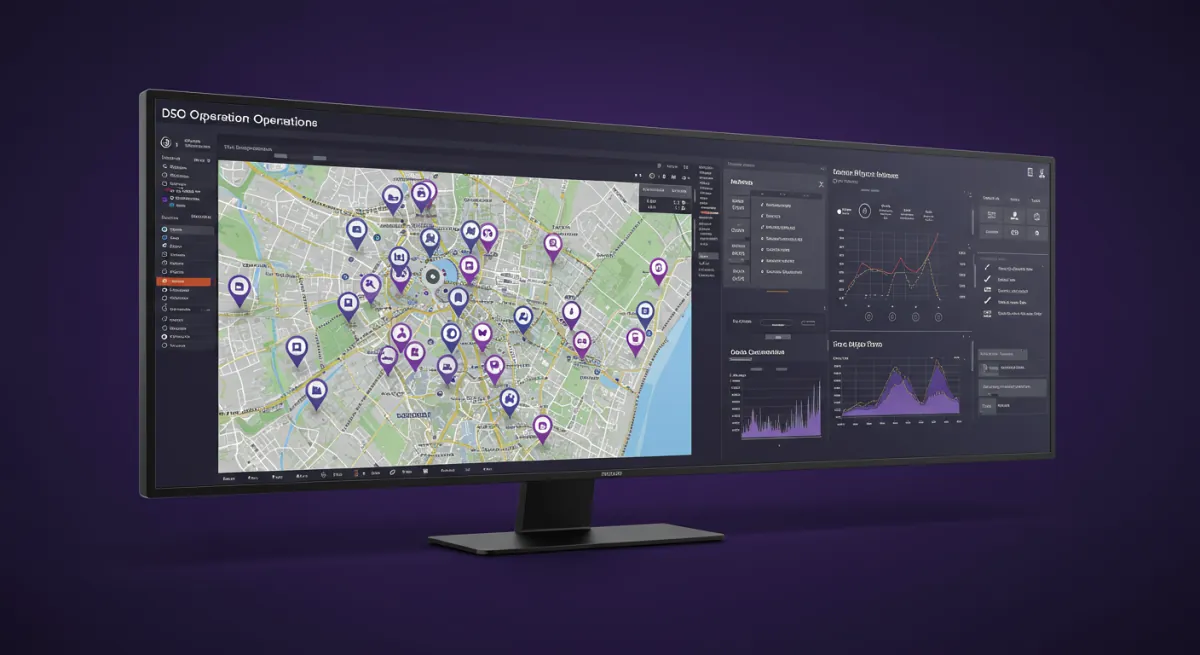
Why Every DSO Needs a Centralized Ops Dashboard
Managing multiple dental practices? Discover how a centralized dashboard can revolutionize your DSO operations.
DSOs in Texas 2025: Complete Guide to Dental Service Organizations
Comprehensive guide to Dental Service Organizations (DSOs) in Texas for 2025. Learn about the Texas DSO landscape, top organizations, market trends, and how AI is transforming dental practices across the Lone Star State.
DSOs in California 2025: Complete Guide to Dental Service Organizations
Comprehensive guide to Dental Service Organizations (DSOs) in California for 2025. Explore the California DSO landscape, major players, regulatory considerations, and how AI is reshaping dental practices in the Golden State.
Ready to stop missing patient calls?
TensorLinks AI answers every call 24/7, books appointments into your PMS, and speaks 24+ languages. Join hundreds of dental practices already using AI reception.