
How many patient calls is your practice missing?
Most dental practices miss 30-40% of inbound calls. See how AI reception can capture every call 24/7.
Your next patient might call while your receptionist is checking someone in. An existing patient might need to reschedule after your office closes. Meanwhile, your team still has reminders to send, questions to answer, and appointments to coordinate.
Which of those conversations can your practice afford to leave unfinished?
When evaluating AI front desk software for dental practices, start there — not with the voice, the dashboard, or the longest feature list.
The goal is to help patients reach the right next step while giving your team less administrative work to chase.
This guide explains what to prioritize, how to test a platform before purchasing, and where TensorLinks AI may fit your practice. It is a TensorLinks-authored buying guide, not an independent ranking of competing products.
What Is AI Front Desk Software?
AI front desk software helps handle patient communication and defined administrative tasks. Depending on the platform, plan, and integration, those tasks can include answering calls, responding to messages, scheduling appointments, sending reminders, and conducting patient recall outreach. TensorLinks AI's offering connects voice, text, and website conversations with practice-management workflows.
The most useful distinction is not whether a system can have a conversation. It is whether that conversation leads to a completed task.
A patient asking for an appointment should leave knowing whether they are booked, waiting for staff approval, or expecting a callback.
An answered call is not the same as a resolved request.
Use that distinction throughout your software evaluation.
What Makes AI Front Desk Software the Right Choice?
For this guide, "best" means best suited to your practice's workflows, patient needs, and operating requirements.
A single-location practice starting with after-hours calls does not necessarily need the same configuration as a dental group coordinating several clinics.
Before reviewing proposals, write down the problem you need to solve. Be specific: "We need to handle eligible after-hours appointment requests" is more useful than "We need more AI."
Then evaluate the following capabilities.
Dental-Specific Scheduling Rules
Make the vendor demonstrate your scheduling rules — not just an open calendar.
Your test should account for the appointment type, provider, location, appointment duration, and operatory where relevant. Include restrictions for new patients, existing patients, and appointments that require staff approval.
For example, ask the system to handle a request for a new-patient visit when the only visible opening is reserved for another appointment type. Does it recognize the restriction? Offer an appropriate alternative? Create a follow-up request?
Do not approve automated booking until you are satisfied with those answers.
The right appointment matters more than the fastest booking.
A Verified Connection to Your Practice Management System
Treat integration as something to test, not a box to check.
Ask whether the platform can read availability, identify the correct patient, create an appointment, and handle the changes your practice intends to automate.
TensorLinks describes an integration process that synchronizes schedules, providers, and appointment types, applies booking preferences, and enables appointments to be booked into the connected practice management system. Confirm the supported actions for your exact deployment.
During the demonstration, inspect the resulting appointment in the practice management system itself. Also test a failed connection — the assistant should distinguish between a submitted request and a successfully confirmed booking.
Communication Channels That Match Your Needs
Decide which channels belong in your initial deployment. You might begin with inbound calls, add two-way texting, or include website scheduling. Outbound recall may be a separate phase.
For each channel, ask the vendor to demonstrate a complete interaction. A website chat that answers questions but cannot schedule is different from one that completes a booking. A reminder notification is different from a two-way conversation that handles the patient's reply.
Avoid buying a feature solely because its name sounds useful. Define the work it must perform and verify that it does it.
Human Handoffs and Clear Boundaries
Build human access into the workflow from the beginning.
Test what happens when a patient requests a person, becomes frustrated, asks a clinical question, or needs an exception to practice policy. Require a useful handoff summary — your staff should be able to see what the patient requested and what has already happened.
Set another rule: when the system lacks approved information, it should clarify or escalate rather than improvise.
Keep diagnosis, treatment advice, sensitive disputes, and clinical judgment outside the assistant's independent responsibilities. Have your clinical team approve urgent-call routing before launch.
Reporting That Shows Outcomes
Ask the vendor to show more than a call count.
Review how the platform distinguishes a successful booking from an appointment request, an answered question from an unresolved conversation, and a completed transfer from an unsuccessful attempt.
During a pilot, track booking accuracy, unresolved requests, correction work, patient complaints, and attended appointments.
A dashboard is useful only when its definitions match the work your practice needs to measure.
Match the Software to Your Practice's Main Goal
Use your most important operational need to shape the demonstration.
| Your main goal | Capabilities to prioritize | Proof to request |
|---|---|---|
| Handle after-hours inquiries | Call answering, approved FAQs, escalation, and appointment-request handling | A complete after-hours interaction, including what happens when booking is unavailable |
| Reduce scheduling administration | Appointment rules, system integration, confirmations, and supported schedule changes | A booking and permitted change completed correctly in your practice management system |
| Coordinate patient communication | Two-way messaging, website conversations, reminders, and clear staff follow-up | A patient reply that leads to a documented next step |
| Support multiple locations | Location-specific configuration, permissions, routing, and reporting | A demonstration showing that each clinic's rules and data access remain correctly separated |
Do not assume that every feature needs to be activated on day one. Choose an initial scope your team can test thoroughly, then expand based on results.
Where TensorLinks AI Fits
TensorLinks AI is designed for dental practices and groups evaluating connected front-desk automation.
Its offering includes around-the-clock call handling, appointment booking into the practice management system, multilingual patient communication, recall workflows, configurable instructions, and escalation to staff. Availability depends on the selected plan and deployment.
For your evaluation, focus on how those capabilities work together. Can an incoming conversation lead to an appropriate booking? Can your team update the assistant's approved information? Can staff take over when the request needs human attention?
For dental groups, TensorLinks also describes centralized management, location-specific scripts and office hours, role-based access, and reporting across clinics. These are useful areas to test when planning a multi-location rollout.
The purchasing decision should rest on the workflows demonstrated for your practice — not on a general promise that AI can handle everything.
TensorLinks AI Pricing in 2026
As of September 21, 2026, TensorLinks publishes the following monthly plans. Prices are in U.S. dollars, per location.
| Plan | Monthly price | Published scope and included usage |
|---|---|---|
| Starter | $399 | Inbound AI voice receptionist; 900 voice minutes |
| Connect | $599 | AI receptionist, two-way SMS, and web chat; 1,000 voice minutes and 1,500 text messages |
| Growth | $799 | Inbound and outbound workflows across channels; 1,500 voice minutes, 3,000 text messages, and 10,000 emails |
The pricing page lists a $199 non-refundable, one-time setup fee. Its 30-day trial waives the monthly subscription charge, not the setup fee. Trial usage is capped at the selected tier's allowance.
Published paid-plan overages are $0.29 per voice minute, $0.06 per text message, and $2 per 1,000 emails. Enterprise arrangements are available for larger groups and additional requirements. Confirm current pricing, applicable usage charges, integration scope, and contract terms before purchasing.
When comparing proposals, include your expected usage rather than looking only at the monthly subscription.
Privacy and Security: What to Check Before Connecting Patient Data
For U.S. dental practices subject to HIPAA, review patient-data handling before enabling a production connection.
HHS explains that a cloud provider creating, receiving, maintaining, or transmitting electronic protected health information on behalf of a covered entity is a business associate. A HIPAA-compliant business associate agreement (BAA) and compliance with the other applicable HIPAA requirements are necessary. Encryption alone does not eliminate these responsibilities.
TensorLinks' security page describes BAA availability, role-based permissions, audit logging, encryption in transit and at rest, and restrictions on integration access. Request the relevant documentation and review how those controls apply to your account.
Ask who can access conversations, how long recordings and transcripts are retained, which subprocessors handle data, whether data may be used for model training, and what happens to records when the agreement ends.
The practice also retains responsibilities. HHS guidance emphasizes understanding the cloud environment and conducting appropriate risk analysis and risk management — signing a BAA does not replace that work.
Have your privacy lead review the deployment, including recording, messaging, consent, and escalation arrangements.
Test the Software Like a Patient, Not a Sales Presentation
Bring a realistic scenario to the demonstration.
For example: a new patient calls after hours and asks for an appointment after work. They decline the first available time, change their preferred day, ask a question about the visit, and then request a staff member.
That single scenario lets you examine several important behaviors. Does the assistant keep track of the changing request? Follow the right appointment rules? Answer only from approved information? Explain whether the appointment is confirmed? Transfer the conversation with an accurate summary?
Next, test a failure. Ask what happens when the scheduling connection is unavailable or the requested staff member cannot answer. Look for a clear explanation and a documented follow-up task — not a false confirmation or a dead end.
Do not approve the platform because the demonstration sounds natural. Approve it when the demonstrated work is accurate.
How to Evaluate the Business Value
Set a baseline before launching. Measure the specific problem you are trying to improve: unanswered eligible calls, appointment requests awaiting follow-up, time spent on routine scheduling, or another clearly defined workflow.
Then compare the pilot with that baseline.
A useful starting calculation is:
Estimated monthly net benefit = incremental contribution from additional attended appointments + realized operating savings − total AI-related costs.
Use contribution after the relevant costs of providing care — not total treatment revenue. Do not count every AI-booked appointment as additional business; some patients would have booked through your existing process.
Likewise, distinguish time saved from cash saved. Giving your receptionist more time for patient service can be valuable without reducing payroll expense.
Include subscription charges, usage fees, setup costs allocated over your evaluation period, training, monitoring, and correction work.
The question is not simply, "Did the AI book appointments?" It is: "Did this deployment improve our operations enough to justify its total cost?"
A Practical Rollout Plan
Begin With a Defined Scope
Choose one initial workflow, such as overflow calls or eligible after-hours appointment requests. Document what the assistant may complete, what needs approval, and which situations require immediate escalation. Give your team a clear way to pause the workflow when necessary.
Prepare the Practice Information
Assign an owner to maintain office hours, provider information, appointment rules, approved answers, and staff contact details. Test holiday hours, unavailable appointment types, and requests outside the assistant's scope. Do not use launch day to discover that the underlying instructions are incomplete.
Review Before Expanding
During the pilot, review a representative sample of conversations and resulting records. Pay particular attention to incorrect bookings, unresolved requests, patient difficulty reaching staff, and time spent correcting the assistant's work.
Expand only after the original workflow meets your practice's acceptance criteria. Treat the launch as the beginning of an operating process — not the end of a software purchase.
Questions to Ask Before Signing
Keep the final purchasing conversation focused on commitments your team can verify.
What exactly is included? Confirm channels, integrations, usage limits, reporting, support, and any functions that require a different plan.
Who is responsible for implementation? Establish who configures the system, tests it, trains staff, maintains instructions, and responds when something fails.
What happens when we leave? Clarify cancellation terms, data access, export options, record retention, and deletion procedures.
Get important commitments in writing. A capability mentioned during a demonstration should not remain an assumption in your implementation plan.
Frequently Asked Questions
What is the best AI front desk software for a small dental practice?
Choose based on the work your practice needs completed accurately. For an initial evaluation, prioritize your scheduling rules, practice management integration, staff handoffs, privacy requirements, and expected total cost. Start with a focused deployment rather than paying for workflows you are not ready to use.
Can AI front desk software replace our reception team?
Treat it as support for defined administrative responsibilities. Keep people accountable for patient relationships, sensitive conversations, clinical coordination, exceptions, and oversight. Evaluate any staffing changes separately from the technology purchase.
Does an AI front desk automatically verify insurance?
Do not assume that collecting insurance details includes checking eligibility or benefits. Ask the vendor to demonstrate each action separately and confirm its availability for your plan, integration, and workflow. Do not let the assistant promise coverage or reimbursement based solely on information collected from the patient.
How long should implementation take?
Build the launch schedule around completed milestones: configuration, integration testing, privacy review, staff training, and approval of the initial workflow. Set a realistic launch date after understanding those requirements, rather than choosing a date first and compressing the testing around it.
Choose Software That Completes the Work
The best AI front desk software for your dental practice should help patients reach an appropriate outcome while making your team's responsibilities clearer — not more complicated.
Look for accurate scheduling, verified integrations, transparent costs, reliable handoffs, and controls your practice can actually use. Then test the platform against your own scenarios.
Ready to evaluate TensorLinks AI for your practice? Book a demo to review your front-desk workflows, test your scheduling requirements, and identify a starting point for automation.
Related articles
More from Dental Practice Technology on TensorLinks.

AI Dental Receptionist vs Dental Answering Service
Should your practice choose an AI receptionist, a live answering service, or a hybrid approach? Compare the work each can complete — not just who answers the call.

AI Dental Receptionist for DSOs and Multi-Location Practices
Standardize patient communication without losing each clinic's identity. Learn how to evaluate and deploy an AI dental receptionist across your dental group.

AI Dental Receptionist for Dentrix: What to Know
Connecting an AI receptionist to Dentrix takes more than checking compatibility. Learn what to verify about scheduling, continuing care, data access, and staff handoffs.
What Is an AI Dental Receptionist? A Complete Guide for U.S. Dental Practices
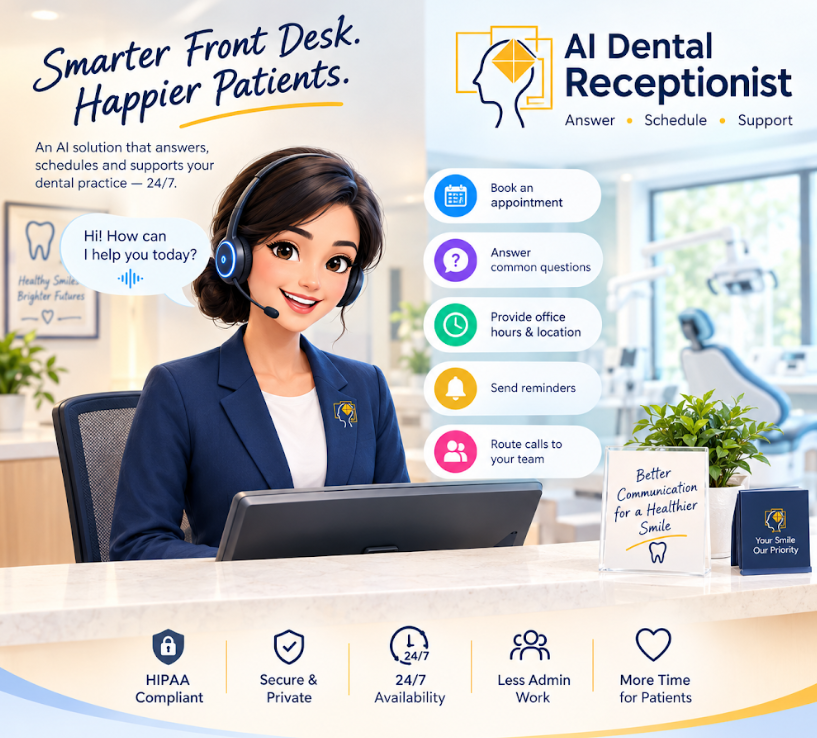
Learn how AI dental receptionists answer calls, schedule appointments, follow up with patients, and support front-office teams while addressing HIPAA, privacy, and U.S. dental practice requirements.
Ready to stop missing patient calls?
TensorLinks AI answers every call 24/7, books appointments into your PMS, and speaks 24+ languages. Join hundreds of dental practices already using AI reception.