
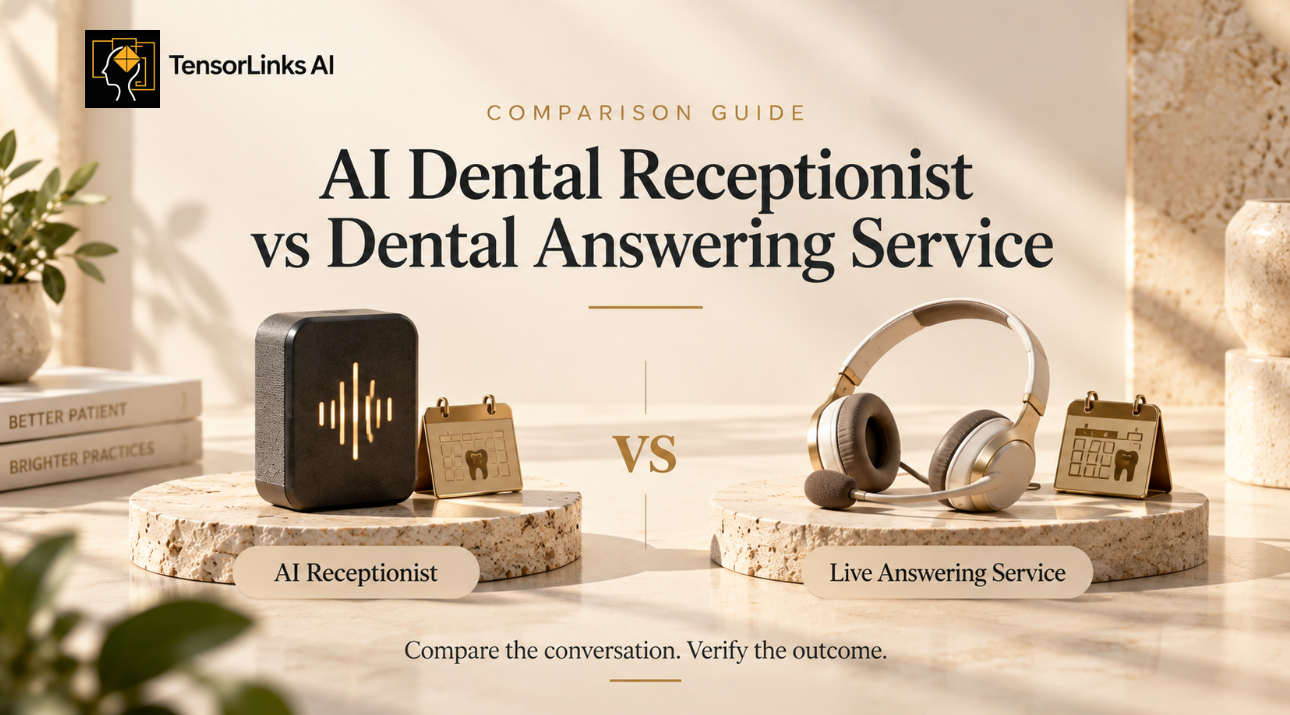
How many patient calls is your practice missing?
Most dental practices miss 30-40% of inbound calls. See how AI reception can capture every call 24/7.
A patient calls your dental practice after closing. They want to schedule an appointment, ask about the first visit, and find out whether someone can help them that evening.
What happens next?
Does someone collect a message for your team? Does the patient get an appointment? Or does the conversation end with another task your receptionist must complete tomorrow?
When comparing an AI dental receptionist vs a dental answering service, start with those outcomes — not just who answers the phone.
Both approaches can support patient communication. The right choice depends on the work you need completed, the human involvement you want, and the systems the service can actually use.
What Is an AI Dental Receptionist?
An AI dental receptionist uses software to handle patient conversations and configured administrative workflows. TensorLinks AI describes capabilities across phone calls, text messages, and website chat, including appointment booking into connected practice management systems and escalation to staff. Availability depends on the plan and configuration.
The key question is not simply whether the AI can speak naturally. It is whether the assistant can understand an approved request, complete the appropriate action, and recognize when your team should take over.
During evaluation, distinguish between a system that collects appointment requests and one that successfully books appointments. Require the vendor to demonstrate the outcome your practice needs.
What Is a Dental Answering Service?
For this comparison, a dental answering service means a service where remote human receptionists answer on behalf of your practice.
Do not assume that these services only take messages. Published live-service offerings can include around-the-clock dental call handling, appointment scheduling, and website chat. The exact scope depends on the provider and service arrangement.
A useful evaluation therefore goes beyond "human versus AI." Ask what the receptionist is authorized and equipped to do. Can they complete a booking in the system your team uses, or will they send your office a request to process later?
A human answering the call does not automatically mean the request is resolved. Neither does an AI answering it.
AI Dental Receptionist vs Dental Answering Service: At a Glance
| Decision factor | AI dental receptionist | Live dental answering service |
|---|---|---|
| Who answers? | Software conducts the conversation using configured instructions and connected tools. | A remote human receptionist conducts the conversation. |
| After-hours availability | Around-the-clock coverage is offered by platforms such as TensorLinks AI. | Around-the-clock coverage is also offered by live answering providers. |
| Appointment scheduling | Direct PMS booking is available through supported integrations. Confirm your exact setup. | Appointment scheduling is available from some providers. Verify whether it uses your PMS or another calendar. |
| Access to a person | Test the transfer process, availability, and fallback when nobody answers. | A person answers initially; verify when they must involve your practice's staff. |
| Messages and follow-up | Texting, chat, and outreach may depend on the selected plan. | Confirm the channels and follow-up tasks included in the agreement. |
| Quality control | Review instructions, conversations, system actions, and exceptions. | Review training, scripts, conversations, system actions, and exceptions. |
1. Compare Completed Work, Not Just Answered Calls
Start with a typical request:
"I would like to book a new-patient appointment next week."
Your evaluation should distinguish three possible outcomes.
A message is captured. Your team receives the patient's details and must call back.
An appointment request is submitted. The patient selects a preference, but staff still need to approve or enter it.
An appointment is confirmed. The appropriate appointment has been successfully saved in the scheduling system.
Any of these may be appropriate for a particular workflow. The problem is treating them as interchangeable. Give both vendors the same scenario. Ask to see exactly what the patient is told and what your staff receives.
If your objective is to reduce routine callbacks, an answered call that creates another callback should not count as a fully resolved scheduling request.
Choose the outcome first. Then evaluate which service can deliver it reliably.
2. Check the Scheduling Connection
Appointment scheduling deserves more scrutiny than a feature checkbox.
Ask both providers to show how they apply your appointment types, provider availability, appointment length, location, and treatment-room requirements where relevant.
TensorLinks describes an integration process that synchronizes schedules, providers, and appointment types, applies booking preferences, and enables appointments to be booked into the connected PMS. Confirm the supported functions for your exact installation.
For a live service, ask which scheduling application the agents use and what permissions they receive. A booking in a separate calendar is not automatically a booking in your practice management system.
Test a request that should not fit an available slot — for example, a new-patient consultation when the opening is reserved for a different appointment type. Then test rescheduling and cancellation separately.
Finally, interrupt the connection during testing. Neither service should tell a patient they are booked when the appointment has not been saved.
3. Evaluate the Patient Experience With Realistic Scenarios
Do not judge either option solely by a polished demonstration.
Use conversations that reflect the patients your practice serves: someone who changes their preferred day, needs information repeated, speaks in a supported language, or has difficulty explaining the request.
For an AI service, evaluate how it handles interruptions, clarification, names, dates, and requests to speak with a person. For a live service, evaluate the receptionist's familiarity with your practice, access to approved information, and ability to stay within authorized responsibilities.
In both cases, ask: Does the patient leave knowing what has happened and what comes next?
Be transparent about the service patients are speaking with. For an AI deployment, use a clear introduction and an easy route to human help. For an outsourced live service, make sure agents do not imply they are physically present at the clinic.
4. Treat After-Hours Coverage as an Operating Process
Around-the-clock availability is not exclusive to AI. Both TensorLinks AI and live dental answering providers advertise 24/7 coverage.
The more useful question is what each service can complete while your office is closed. Define which requests may be resolved immediately and which require follow-up. Establish who receives unresolved tasks, how those tasks are prioritized, and when patients should expect a response.
Also test overlapping calls, failed transfers, and unavailable scheduling connections. Ask each provider to explain capacity limits and contingency arrangements in writing.
Do not equate "24/7 answering" with guaranteed instant pickup, uninterrupted availability, or unlimited simultaneous calls unless those commitments are explicitly supported.
Coverage should include a clear next step — not merely an open phone line.
5. Keep Clinical Questions and Sensitive Exceptions With Your Team
A receptionist service should operate within an approved administrative scope.
Have your clinical team establish urgent-call routing and escalation instructions. Do not assign either an AI assistant or a non-clinical remote receptionist independent responsibility for diagnosis, treatment recommendations, or deciding that an urgent concern can wait.
Similarly, establish human-review pathways for complaints, billing disputes, uncertain patient identity, and exceptions to practice policy.
When transferring a conversation, require a useful summary of the request and any actions already attempted. When a live transfer is unavailable, create a follow-up task with a clear owner. Avoid vague promises such as "someone will call soon" unless your practice has defined and can meet that expectation.
The goal is continuity — not forcing patients to restart the conversation every time responsibility changes.
6. Compare Total Cost, Not Just the Advertised Price
Build the comparison around the same expected call volume, coverage periods, and responsibilities.
Ask how each proposal accounts for subscriptions, included usage, overages, setup, integrations, transfers, additional locations, and optional communication channels. Clarify how billable time is measured, including transferred or unsuccessful calls.
As of September 21, 2026, TensorLinks lists its Starter plan at $399 per location per month, including 900 voice minutes, with additional voice usage at $0.29 per minute and a $199 one-time setup fee. Confirm current terms before purchasing.
Do not compare that price with an unrelated staffing estimate or assume that every live service will cost more. Obtain a quote for the same workload.
A useful calculation: Total monthly operating cost = service charges + applicable usage and add-ons + allocated setup costs + internal time spent reviewing, correcting, and completing work.
Then consider value. Time freed for in-office patient service is useful, but it is not automatically a payroll saving. Similarly, an appointment booked through the service is not necessarily additional revenue if the patient would have booked anyway. Judge the deployment against your baseline rather than a vendor's general savings promise.
7. Apply Privacy Requirements to Both Models
For U.S. dental practices subject to HIPAA, outsourcing to a human service does not remove patient-data responsibilities. HHS guidance generally treats vendors performing covered functions involving protected health information on a practice's behalf as business associates, requiring appropriate business associate agreements and safeguards.
Review the proposed data flow before enabling access. Ask who can see patient information, where recordings and transcripts are stored, how long records are retained, which subcontractors process them, and what happens when the agreement ends. For AI services, ask explicitly about model-training uses.
HHS also advises organizations using cloud services to understand the environment and conduct their own risk analysis and risk management. A signed agreement does not replace that assessment.
TensorLinks' security documentation describes BAA availability, role-based permissions, audit logging, encryption, and limits on integration write operations. Request the relevant documentation and review the controls applicable to your account.
Which Approach Should Your Practice Evaluate?
Consider AI-Led Coverage for Defined, Repeatable Workflows
Consider an AI-led pilot when your priority is automating clearly defined administrative work and you are prepared to configure, test, and maintain the rules. Make verified scheduling, accurate follow-up, and usable staff handoffs part of the acceptance criteria. Do not select AI solely because it sounds modern or because a demonstration resembles a human conversation.
Consider Live Answering When a Human First Response Is a Requirement
If your practice's service model requires a person to answer initially, evaluate live providers against that requirement. Then examine the rest of the workflow: practice-specific training, scheduling access, escalation, privacy, and the amount of follow-up left for your staff. A human first response may satisfy an important preference without, by itself, proving that the entire administrative process is complete.
Consider a Hybrid Arrangement When Responsibilities Can Be Clearly Divided
A proposed hybrid setup might assign approved routine requests to AI and route selected conversations to your staff or a contracted live service. Treat this as a workflow to verify — not a capability to assume. Confirm that the providers support the transfers, summaries, coverage, and billing arrangements you need. Make ownership explicit so a patient is not passed between services without anyone resolving the request.
Test Both Options With the Same Pilot
Use the same scenarios, definitions, and review process. Choose a limited initial scope, such as eligible after-hours appointment requests. Record your existing performance before launch, then review the pilot against that baseline.
Track correctly completed bookings, unresolved requests, patient complaints, and staff time spent correcting or finishing work. For scheduling requests, follow the outcome through to attendance where practical.
Ask your team to inspect the resulting records — not just listen to conversations. Set acceptance criteria before expanding. A pleasant conversation should not offset an incorrect booking, and a high answer rate should not hide a growing queue of unfinished requests.
Frequently Asked Questions
Can a live dental answering service book appointments?
Some live providers advertise appointment scheduling. Confirm whether the service books directly into your PMS, uses another scheduling tool, or sends a request for your team to complete.
Is an AI dental receptionist always cheaper?
Do not assume so. Compare written quotes for the same workload and include usage charges, setup, monitoring, correction work, and any human support the deployment requires.
Can either service handle insurance verification automatically?
Treat insurance-detail collection, eligibility verification, and coverage estimates as separate capabilities. Request a demonstration of the exact workflow rather than inferring it from a general "insurance support" label.
Does either option replace the in-office front desk?
Plan the service around defined remote responsibilities. Keep your team accountable for in-person patient care, clinical coordination, sensitive conversations, exceptions, and oversight. Evaluate staffing decisions separately from the purchase.
Choose the Service That Completes the Right Work
The decision is not simply AI versus people. It is about the patient experience you want, the tasks you need completed, and the responsibilities your practice must retain.
Compare scheduling accuracy, staff handoffs, privacy, total cost, and patient outcomes. Require proof of the complete workflow.
Ready to evaluate TensorLinks AI alongside your current answering setup? Book a demo to test your scheduling requirements, review patient handoffs, and identify a focused starting point for automation.
Related articles
More from Comparison on TensorLinks.

AI Dental Receptionist for DSOs and Multi-Location Practices
Standardize patient communication without losing each clinic's identity. Learn how to evaluate and deploy an AI dental receptionist across your dental group.
AI Dental Receptionist for Dentrix: What to Know
Connecting an AI receptionist to Dentrix takes more than checking compatibility. Learn what to verify about scheduling, continuing care, data access, and staff handoffs.
Best AI Front Desk Software for Dental Practices in 2026
Choosing an AI front desk takes more than comparing voices and feature lists. Learn what to test, how to assess costs, and where TensorLinks AI fits your dental practice.
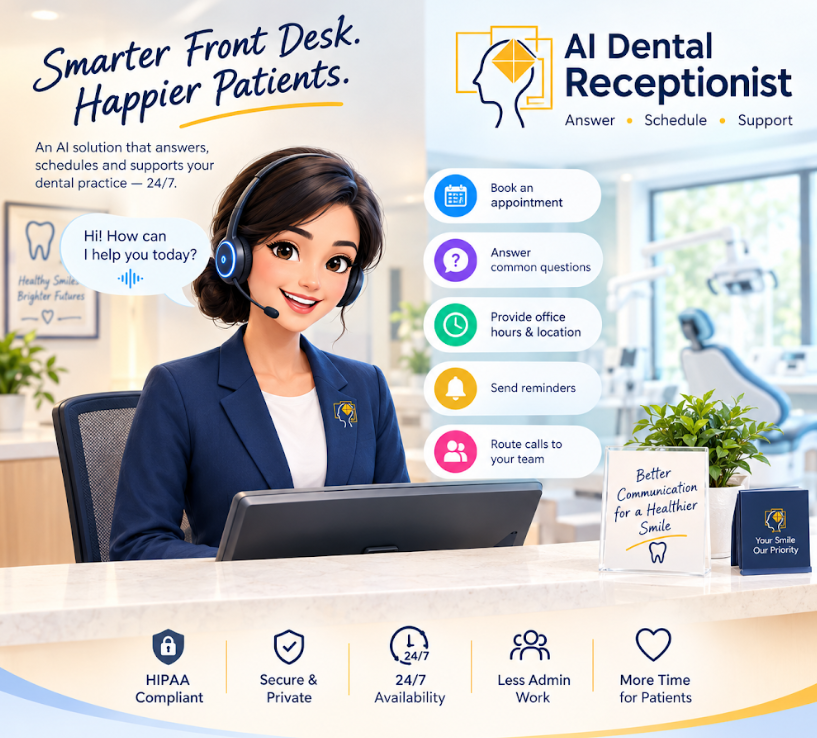
What Is an AI Dental Receptionist? A Complete Guide for U.S. Dental Practices
Learn how AI dental receptionists answer calls, schedule appointments, follow up with patients, and support front-office teams while addressing HIPAA, privacy, and U.S. dental practice requirements.
Ready to stop missing patient calls?
TensorLinks AI answers every call 24/7, books appointments into your PMS, and speaks 24+ languages. Join hundreds of dental practices already using AI reception.