
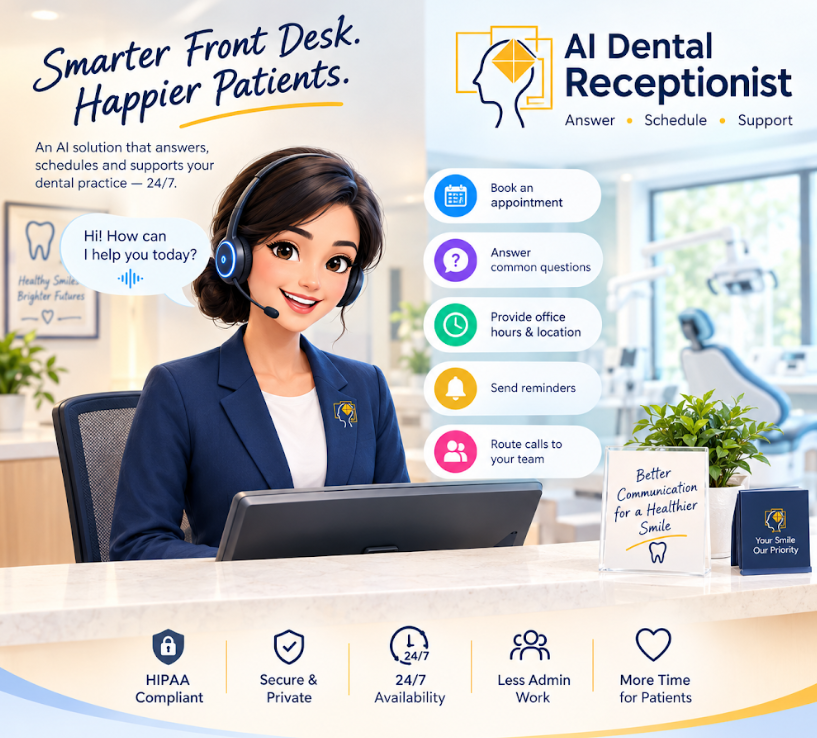
How many patient calls is your practice missing?
Most dental practices miss 30-40% of inbound calls. See how AI reception can capture every call 24/7.
The dental front desk is often the first point of contact between a patient and a dental practice. Phones ring, patients need appointments, insurance questions come in, and staff members may have to manage several tasks at once.
An AI dental receptionist is a technology solution designed to help manage many of these routine communication and administrative tasks using artificial intelligence.
Unlike a traditional answering service, an AI receptionist can interact with patients through natural-language conversations, answer frequently asked questions, collect information, schedule or request appointments, send reminders, and route conversations to the appropriate member of the dental team.
For U.S. dental practices, however, implementing AI requires more than simply choosing a conversational AI tool. Practices need to consider HIPAA, patient privacy, data security, state requirements, communication rules, accessibility, and appropriate human oversight. The American Dental Association (ADA) emphasizes that AI should support professional judgment rather than replace it.
What Is an AI Dental Receptionist?
An AI dental receptionist is an AI-powered virtual front-desk assistant that communicates with patients by phone, text, chat, or other digital channels.
Depending on how it is configured, it may be able to:
- Answer incoming calls
- Respond to common patient questions
- Schedule appointments
- Reschedule or cancel appointments
- Confirm appointments
- Collect basic patient information
- Send appointment reminders
- Follow up with prospective patients
- Route urgent or complex calls to staff
- Provide practice hours and location information
- Explain basic administrative processes
- Handle after-hours inquiries
The important distinction is that an AI receptionist is primarily an administrative and communication tool. It should not independently diagnose dental conditions, prescribe treatment, or replace the professional judgment of a licensed dentist.
The ADA's current AI policy supports using AI to supplement rather than replace or override a dentist's clinical judgment and emphasizes patient safety, privacy, validation, and appropriate supervision.
How Does an AI Dental Receptionist Work?
A typical AI receptionist combines several technologies:
1. Voice or Chat AI
The system understands a patient's question and generates a conversational response. For example:
"I'd like to schedule a cleaning next week."
The AI can identify the request and proceed according to the practice's scheduling rules.
2. Practice Information
The AI can be configured with information such as office hours, location, services offered, accepted insurance information, new-patient procedures, appointment policies, cancellation policies, and frequently asked questions.
3. Scheduling Integration
If properly integrated with the practice's scheduling or practice-management system, the AI may be able to check appointment availability and perform permitted scheduling actions.
4. Human Escalation
When a question falls outside the AI's approved responsibilities, the conversation can be transferred or routed to a human team member. For example, a patient reporting severe swelling after a procedure should be directed to qualified dental or emergency assistance — not assessed by AI.
What Can an AI Dental Receptionist Do?
Answer Calls 24/7
One of the most common uses is answering calls outside normal office hours. Instead of reaching voicemail, a patient may receive an immediate response to basic questions. This can be particularly useful for new-patient inquiries, appointment requests, office-hours questions, and routine administrative questions.
Schedule Dental Appointments
An AI receptionist can help automate appointment scheduling when it is connected to the practice's scheduling system. The exact functionality depends on the software integration and permissions provided to the AI.
Reduce Missed Calls
A missed call can represent a missed opportunity for a dental practice. When staff members are assisting patients in the office, checking patients in, or handling other administrative work, they may not always be able to answer every call. An AI receptionist can provide another channel for handling incoming inquiries instead of allowing every unanswered call to become voicemail.
Appointment Reminders and Confirmations
AI-powered systems can also assist with appointment communications. However, dental practices should pay attention to applicable federal and state requirements governing calls and texts. Rules can apply to automated or prerecorded calls and texts, and requirements vary depending on the purpose and content of the communication.
Answer Frequently Asked Questions
Patients frequently ask questions such as "What time do you open?", "Do you offer emergency appointments?", and "How do I cancel my appointment?" An AI receptionist can answer questions that have been approved and configured by the practice.
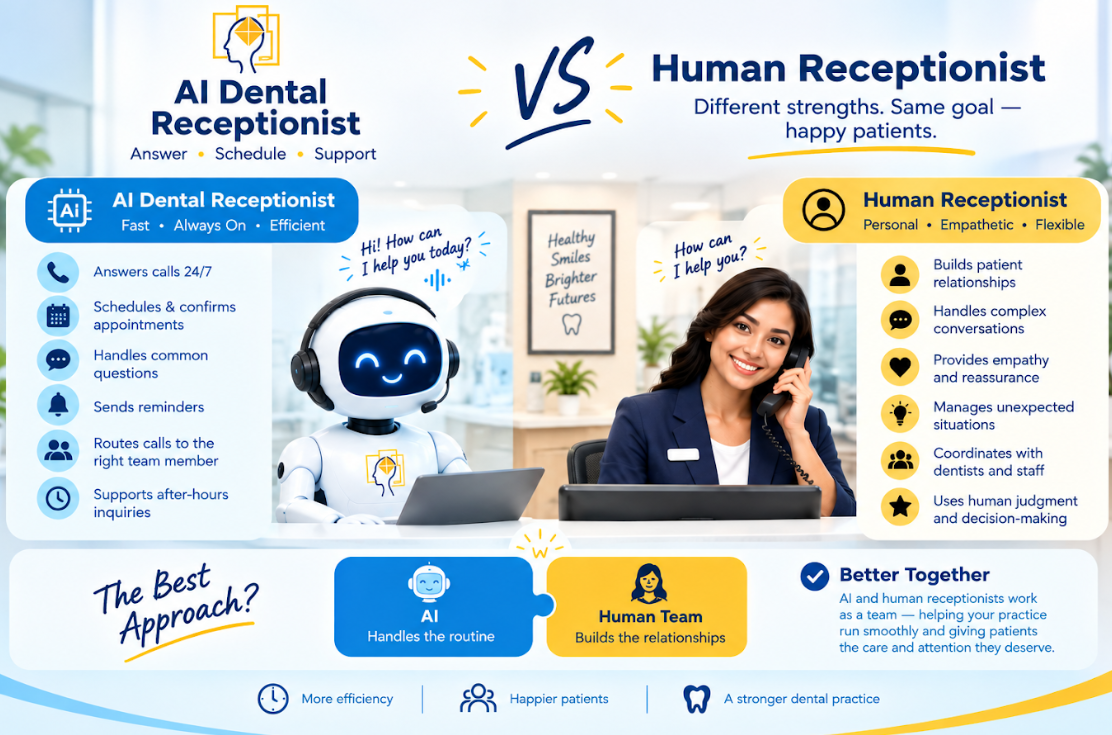
AI Receptionist vs. Traditional Dental Receptionist
An AI receptionist should generally be viewed as a support tool, not necessarily a replacement for the human front-office team.
A strong implementation allows AI to handle repetitive administrative work while human staff focus on patients who require personal attention.
Is an AI Dental Receptionist HIPAA Compliant?
This is one of the most important questions for a U.S. dental practice. AI itself is not automatically "HIPAA compliant." HIPAA compliance depends on how the technology is designed, configured, used, and integrated into the practice's overall privacy and security program.
If an AI vendor handles PHI on behalf of a covered dental practice, the vendor may qualify as a business associate. HHS specifically lists third-party AI chatbots that handle PHI for activities such as symptom assessment, reminders, and appointment scheduling as an example of a potential business associate relationship.
In those circumstances, the practice may need an appropriate Business Associate Agreement (BAA) with the vendor.
What Should Dental Practices Ask an AI Vendor About HIPAA?
- Does the system handle PHI? Determine what patient information the system collects, stores, processes, or transmits.
- Is a BAA available? If the vendor is acting as a business associate, the appropriate contractual arrangement should be addressed.
- Where is patient information stored? Understand how information is stored, transmitted, retained, and deleted.
- Is patient data used for AI training? The practice should understand whether information submitted to the system is used to train models or for other purposes.
- What security controls are available? Ask about authentication, access controls, encryption, audit logging, data retention, and incident response.
- What happens if the system makes an error? There should be a process for identifying, correcting, and escalating inappropriate AI responses.
Can an AI Receptionist Give Dental Advice?
An AI receptionist should have clearly defined boundaries. There is a significant difference between "Our office is open Monday through Friday from 8 AM to 5 PM" and "Your tooth pain means you have an abscess." The first is administrative information. The second is a clinical assessment.
Dental AI should not be presented as a substitute for a licensed dental professional. Practices should establish escalation rules for dental emergencies, severe pain, trauma, bleeding, swelling, medication questions, diagnosis questions, treatment recommendations, complicated insurance questions, and requests involving protected health information.
AI Dental Receptionists and Patient Privacy
Patient trust is particularly important in dentistry because dental practices handle sensitive health and personal information. An AI receptionist should be configured to collect only the information necessary for its intended task.
The practice should establish policies for:
- What information the AI can collect
- Who can access conversations
- How long information is retained
- Where information is stored
- When information is transferred to staff
- How security incidents are handled
AI Receptionists and Phone/Text Communications
Dental practices should also consider communication laws when deploying automated calling or texting systems. Federal laws, including the Telephone Consumer Protection Act (TCPA), can apply to calls and texts, particularly when communications involve automated or prerecorded technology or marketing. State laws may impose additional requirements.
Healthcare-related communications may receive different treatment from marketing communications. Practices should distinguish between administrative communications (appointment reminders, confirmations, treatment-related instructions) and marketing communications (promotional offers, advertising, sales campaigns).
What About State Dental Boards?
Dental practice regulation is largely state-based, while federal laws such as HIPAA may apply across the country when their requirements are triggered. A dental practice considering AI should consider federal requirements, applicable state laws, state dental board rules, privacy requirements, professional standards, the practice's own policies, and vendor contracts and security controls.
For that reason, an AI receptionist should not be marketed as a universally compliant solution simply because it claims to be "HIPAA compliant."
Benefits of an AI Dental Receptionist
When appropriately implemented, an AI receptionist can help a dental practice:
- Improve responsiveness — Patients can receive immediate responses to routine questions.
- Reduce repetitive administrative work — Staff can spend less time answering the same basic questions repeatedly.
- Support after-hours communication — Patients can interact with the practice outside traditional front-desk hours.
- Improve appointment workflows — AI can assist with appointment requests, confirmations, reminders, and follow-ups.
- Support lead management — New-patient inquiries can be captured and routed instead of being lost.
- Give staff more time for patients — By handling routine interactions, AI may allow human receptionists to focus on patients physically present in the office.
Potential Risks and Limitations
- Incorrect information — AI systems can generate incorrect or misleading responses. The ADA specifically identifies accuracy risks and the possibility of AI "hallucinations," making human review important.
- Privacy and security — Improperly configured systems can create risks involving PHI.
- Poor escalation — A system that fails to recognize a situation requiring human intervention can create patient-safety concerns.
- Communication errors — An AI may misunderstand a patient's request, particularly with accents, background noise, unusual names, or complex questions.
- Integration problems — An AI receptionist connected incorrectly to scheduling software could create administrative errors.
- Accessibility — Patient-facing technology may also need to meet applicable accessibility requirements.
How to Choose an AI Dental Receptionist
Before selecting a platform, dental practices should evaluate more than the AI's conversational ability. Look for:
- HIPAA and privacy capabilities — understand exactly how PHI is handled
- Business Associate Agreement availability
- Dental software integrations with the practice's existing systems
- Clear human escalation pathways to staff
- Customizable workflows for scheduling and communication policies
- Audit and reporting capabilities to monitor interactions
- Strong security controls — encryption, access management, data retention, incident response
- Transparent AI behavior — the practice should know what the system can and cannot do
Questions to Ask Before Implementing AI
- Does the AI handle PHI?
- Is a BAA available where required?
- Where is patient data stored?
- Is patient data used to train AI models?
- How long is data retained?
- Can the practice delete or export data?
- Does the system integrate with our practice-management software?
- Can calls be transferred to staff?
- Can we create custom escalation rules?
- Can the AI be prevented from giving clinical advice?
- How are emergency situations handled?
- What audit logs are available?
- What happens if there is a security incident?
- What state-specific requirements should our practice consider?
See how TensorLinks handles HIPAA compliance, PMS integrations, and human escalation in a live demo.
Book a Demo →The Future of the Dental Front Desk
AI is increasingly becoming part of healthcare and dental technology. The ADA has already established standards and policies addressing aspects of AI in dentistry, including safety, efficacy, transparency, fairness, privacy, and clinical oversight.
For dental practices, the opportunity is not about replacing the human front desk. Instead, AI can be used to augment the front-office team. A human receptionist can focus on patient relationships, complex situations, coordination, and empathy, while an AI assistant handles appropriate repetitive administrative tasks.
The goal is a front desk that is more responsive, more efficient, patient-focused, and appropriately supervised.
Final Takeaway
An AI dental receptionist is an AI-powered administrative assistant that can help dental practices manage patient communications, appointment workflows, routine questions, reminders, and other front-office tasks.
But implementing one in a U.S. dental practice requires careful attention to HIPAA, PHI, business-associate requirements, communication laws, state requirements, accessibility, security, and human oversight.
AI should support the dental team — not replace professional judgment or patient care.
For any specific implementation, dental practices should review their workflow with qualified legal/compliance professionals and verify applicable state requirements rather than relying solely on a vendor's compliance claims.
Sources: American Dental Association — Artificial Intelligence in Dentistry; American Dental Association — HIPAA Resources; HHS — Business Associates and HIPAA; American Dental Association — Phone and Text Rules
Tags: ai dental receptionist, HIPAA compliant AI, dental front desk automation, virtual dental receptionist, dental AI software, AI appointment scheduling, dental practice management, business associate agreement, TCPA dental, dental answering service alternative
Related articles
More from Industry Insights on TensorLinks.

How Much Does an AI Dental Receptionist Cost in 2026?
AI dental receptionist pricing in 2026 ranges from $50 to $1,500+/month depending on call volume, PMS integration, and automation level. Here is what dental practices should expect to pay and what to ask before choosing a vendor.
AI Dental Receptionist vs. Human Receptionist: A Complete Comparison
AI is best used to support — not replace — the human dental team. Learn how AI and human receptionists compare across availability, HIPAA compliance, scheduling, and patient care so your practice can make the right decision.
The Evolution of AI Agents: From Simple Assistants to Proactive Systems
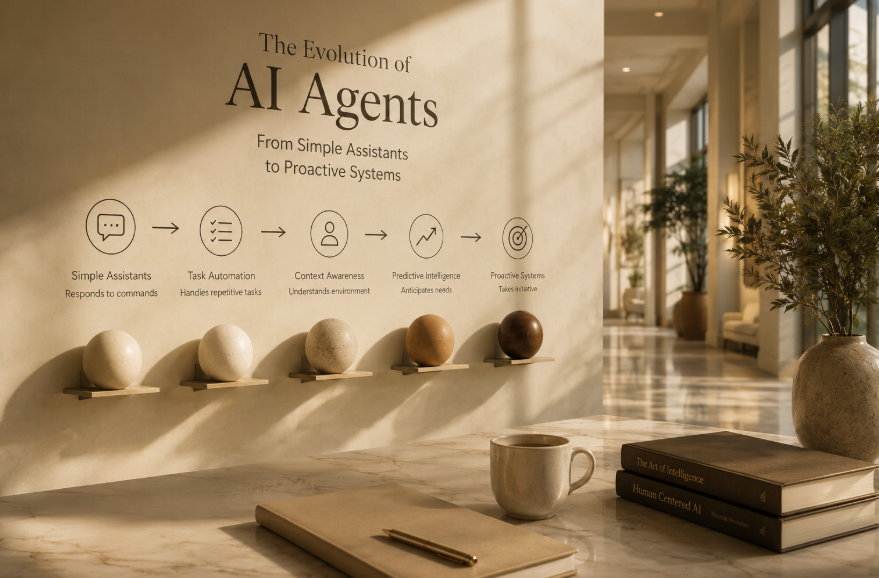
Most people still think of AI agents as chatbots — you ask, they answer. That is only the first rung. This is the four-stage path from simple assistants to proactive, monitoring systems, why it is becoming real in 2026 (OpenClaw, Claude Code, Codex), and the real shift underneath: AI moving from a chatbot to infrastructure.

TensorLinks Joins Henry Schein One API Exchange as an Authorized Integration Vendor
TensorLinks' AI FrontDesk platform now safely and securely integrates with Dentrix Ascend to help dental practices build their best platform.
Ready to stop missing patient calls?
TensorLinks AI answers every call 24/7, books appointments into your PMS, and speaks 24+ languages. Join hundreds of dental practices already using AI reception.